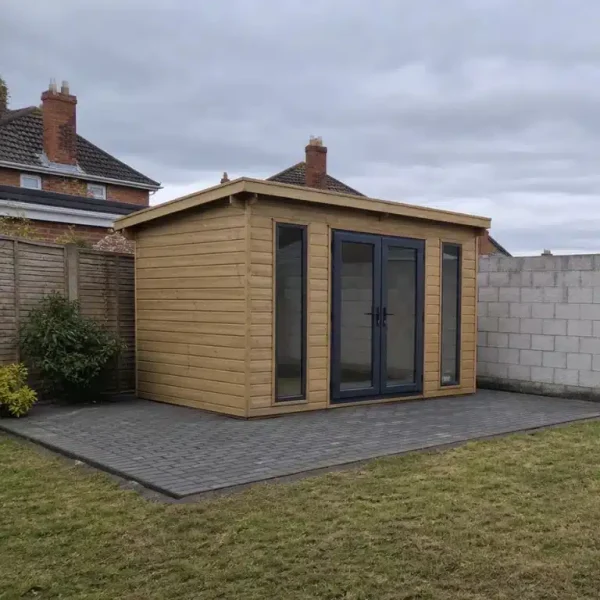
Huntstown, Dublin 15, D15 WY81

Cobblelock Shed Base Dublin - A Premium Look for Your Garden Building (2026)

Table of Contents
cobblelock shed base dublin

Most of the time, when somebody asks us about a cobblelock shed base, they’ve already got cobblelock somewhere else in the garden. Driveway, patio, side path. They want the shed to match. Fair enough.

A cobblelock shed base in Dublin typically costs between €100 and €140 per square metre including materials, sub-base prep, and labour. For a standard 2.4m x 1.8m (8ft x 6ft) shed, you’re looking at roughly €430 to €600 all-in. That’s in line with a poured concrete pad and below a paving slab base on price, and honestly? For the right job, it’s the most attractive base option you can put under a garden building.

But cobblelock isn’t right for every shed. There are jobs we’d talk a customer out of doing in block paving. Let me walk you through it.

What a Cobblelock Shed Base Actually Is

Quick clarification, because the words get used loosely. Cobblelock is a brand name that became a generic term in Ireland – same way “Hoover” became the word for vacuum cleaner. What we’re really talking about is interlocking concrete block paving. Small rectangular blocks, around 200mm x 100mm, laid on a sand bed over a compacted hardcore sub-base, with the joints filled with kiln-dried sand.

Properly built, a cobblelock base has four layers under the shed:

  1. Excavated ground – dug out to depth.
  2. Compacted 804 hardcore sub-base – the structural layer.
  3. Sharp sand bedding – around 30-40mm deep, screeded flat.
  4. The block paving itself – laid in pattern, edge-restrained, joints sanded.
 

That edge restraint bit matters. Without a proper edging course or a concrete haunching around the perimeter, the blocks slowly creep outwards over time and the whole base loosens up. We’ve seen DIY jobs where the edge has spread by 50mm in two winters. Total mess.

When Cobblelock Makes Sense Under a Shed

Honest answer? It’s a niche choice. Brilliant for some jobs, wrong for others.

Cobblelock works well for:

  • Smaller timber or steel sheds, up to about 2.4m x 1.8m (8ft x 6ft). Light enough that the load spreads evenly across the blocks.
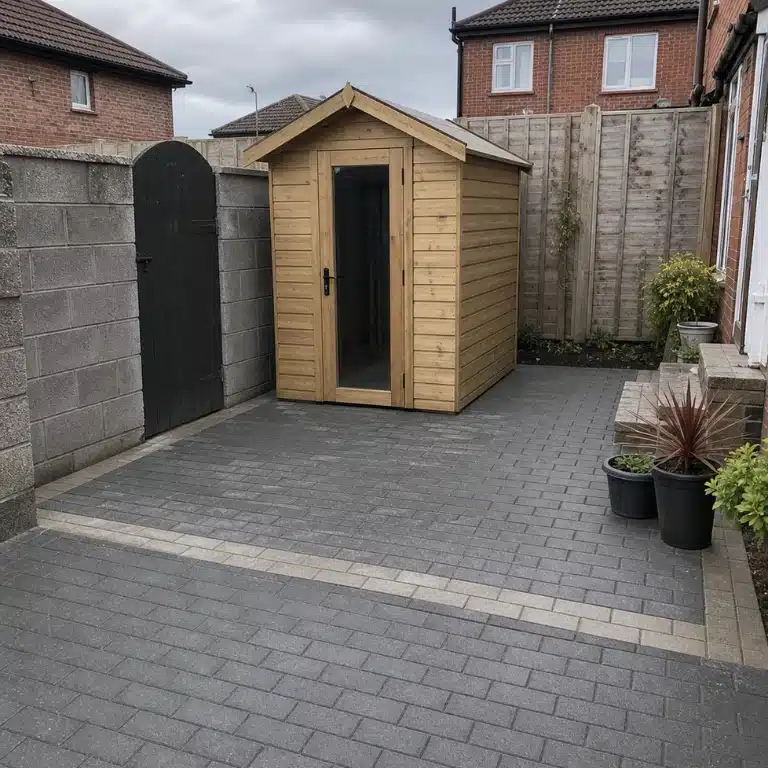
  • Gardens where there’s already cobblelock in place. Driveway, patio, paved paths. Matching the shed base to existing paving makes the garden feel finished.
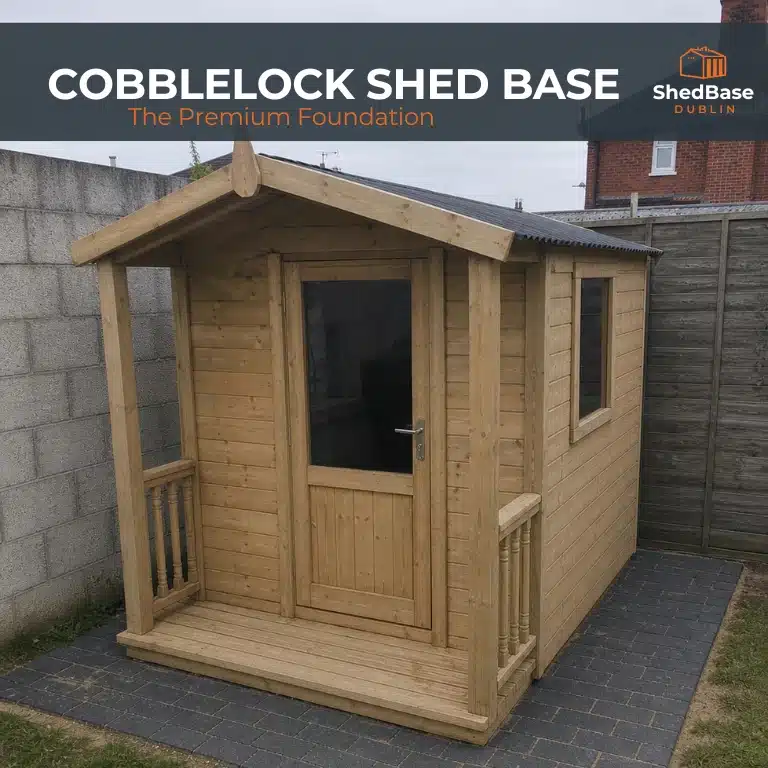
  • Decorative or feature sheds. Summerhouses, garden offices used occasionally, hobby sheds. The aesthetic carries weight when the shed itself is a garden feature.
  • Permeable garden setups. Block paving lets water drain through the joints into the ground below – much better than a solid concrete pad in clay-heavy parts of Dublin 15.
 

Cobblelock isn’t the right call for:

  • Heavy garden offices or proper workshops. Concentrated weight on a single block can cause it to sink or rock. Concrete is the only sensible option for serious load-bearing.
  • Large sheds. Anything over 3m x 2.4m (10ft x 8ft) starts to push the limits of what a sand-bedded base can hold level long-term.
  • Budget jobs. If the priority is keeping the cost down, a gravel shed base does the same structural job for around 40% less.
  • Sites with no edge support. If there’s nothing to butt the blocks up against – no wall, no kerb, no edging course – the whole thing relies on a concrete haunching that needs proper installation. Skip that step and you’re in trouble.

For a side-by-side comparison of how cobblelock stacks up against concrete, slabs, and gravel, our shed base materials guide covers all four.

cobblelock shed base summerhouse dublin
Driveways and Patios place picture
4.9
Based on 107 reviews
Caroline Butler profile picture
Caroline Butler
3 days ago
Zim and his team did 2 pieces of work for us, originally we had a concrete base for a shed, and later had the concrete extended the full length of the garden. Both times the lads were great. They were respectful, efficient, friendly & very tidy. We’re delighted with the results & would highly recommend!
Barry Kestell profile picture
Barry Kestell
2 months ago
Brilliant job, very hard workers! Really happy with the results and highly recommend to anyone
declan davis profile picture
declan davis
2 months ago
I have never seen a contractor deliver this standard and finish of work. They arrived at 08:00am and were leaving each day at 7pm. Zim and his time were so organised & professional , incredible work ethic. He kept checking with my wife & I as he progressed and made suggestions which made the finished patio look amazing. The levels, stepping down and marrying into the house and garden is beautifully finished, thank you so much Declan & Ann Marie
Jennifer Jones profile picture
Jennifer Jones
3 months ago
Had Zim out to lay a slab of concrete for my shed. Would highly recommend him very clean and tidy.
John Kealy profile picture
John Kealy
3 months ago
Zim and his team put in a concrete base for a new garden shed. They showed up on time, did a fantastic job and made everything neat and tidy before leaving. Genuinely impressed and highly recommended. John
Lisa Courtney profile picture
Lisa Courtney
3 months ago
Zim and his team are excellent to deal with and their work is top notch. Delighted with our patio and would recommend to all. Thank you Zim.
Fabion Tahiraj profile picture
Fabion Tahiraj
3 months ago
Absolutely delighted with the shed base. Excellent workmanship, professional from start to finish, and left everything clean and tidy. The base is perfectly level and built to a very high standard. Highly recommend!
Shane Wallace profile picture
Shane Wallace
3 months ago
I am delighted with the great job that Zim and team did in my garden installing a porcelain patio, fencing and shed. The quality of the work is top class. It’s exactly what I wanted and delivered at a good price. I have already recommended Zim to many of my friends. Thanks again lads.
James Short profile picture
James Short
2 years ago
Zim was a pleasure to deal with. Brilliant service, quality workmanship, great communication throughout and excellent value for money. Would highly recommend Zim and his hard working team for any paving works.
Great job. Zim is very approachable and super nice. Our front yard needed few changes and Zim’s team have it done for us in one day. We are very happy and we highly recommend their service.
bbgs murphy profile picture
bbgs murphy
2 years ago
Would like to thank Zim and his crew for the wonderful work they did on our garden ,we had an old deck taken up and these beautiful porcelain tiles put down, the detail that was taken was just incredible , can't recommend Zim enough ,so professional and such clean work ,it was an absolute pleasure .thank you so much and looking forward to you coming back to do another job for us . Martin and Linda

How We Build a Cobblelock Shed Base

Most cobblelock shed bases take a full day, sometimes a day and a half if the access is awkward. Here’s the rough process.

1. Excavate. We mark the shed footprint plus 100-150mm extra on every side for the edging. Then dig down around 200-250mm depending on the soil. North Dublin clay tends to need the deeper end of that range because the ground holds water and we want a generous hardcore depth to work as a soakaway.

2. Lay the sub-base. 150mm of compacted 804 hardcore, in two passes with the whacker plate. Compaction matters more here than on most other base types. Block paving sits on sand, sand sits on the hardcore – if the hardcore moves, the whole thing moves.

3. Install the edge restraint. Either a perimeter edging block bedded in concrete, or a concrete haunching around the full edge of the area. This locks the blocks in and stops them spreading out over time. Non-negotiable. We’ve never had a base fail in this part of the build, and it’s because we don’t skip this step.

4. Screed the sand bed. 30-40mm of sharp sand, screeded perfectly flat between the edging. This is the bit that gives the blocks their final level. Get it wrong and the whole surface looks wavy.

5. Lay the blocks. Pattern’s up to the customer. Stretcher bond is the most common – blocks laid like brickwork, offset by half. Herringbone gives a more decorative look but takes longer. We work from a corner outward, keeping the lines true with a string line. Cuts at the edges go in last.

6. Compact and joint. Once all blocks are laid, we run a plate compactor with a rubber mat over the whole surface to settle them into the sand. Then kiln-dried jointing sand is brushed across and worked into the gaps between every block. Final compaction. Job done.

A neighbour in Castleknock had us do one of these last summer. Existing cobblelock driveway, customer wanted a small 2.4m x 1.8m (8ft x 6ft) timber summerhouse to match. We dug out the corner of the back garden, laid 200mm of 804, perimeter edging haunched in concrete, sharp sand bed, and laid the blocks in a stretcher bond pattern using leftover stock from the driveway job five years earlier. Total cost was around €520. Looks like the summerhouse was always meant to be there.

Cobblelock vs Other Shed Base Types

Here’s the full picture. For a standard 2.4m x 1.8m (8ft x 6ft) shed in Dublin.

Base TypeCostLookDrainageBest For
Stabilised gravel€260 – €390FunctionalExcellentSmall light-use steel sheds
Paving slabs€540 – €820Tidy, formalGoodSmaller sheds, neat finish
Cobblelock€430 – €600Premium, integratedVery goodFeature sheds, matching existing paving
Concrete pad€430 – €645PlainPoor (needs channels)Heavy buildings, workshops, offices

Pricing update, September 2026: our paving slab bases are now €125 – €190 per m², around 25% above an equivalent poured concrete base. Slabs use more materials and every one of them is bedded and levelled by hand. The final price depends on size, ground preparation and access.

So you’re paying a bit of a premium for the aesthetic. About €100-200 more than gravel, similar to concrete on raw cost. Where cobblelock wins is the way it sits in the garden. A concrete pad always looks like a concrete pad. Block paving looks like part of the landscaping.

For the full breakdown across all base types and how access affects pricing, our shed base cost guide has the detail.

What About the Damp?

Steel sheds especially need to be thought through here. Block paving has joints. Joints let air pass through, but they also let water reach the underside of the shed if there’s no membrane.

For any steel shed going on a cobblelock base, we always lay a DPM (Damp Proof Membrane) on top of the blocks before the shed itself goes down. The DPM stops rising moisture and condensation from below. Cut to fit, taped at the edges. Adds maybe €25-30 to the job and saves you from rust problems three winters down the line.

For timber sheds, the same logic applies but it’s less critical. Wood handles minor damp better than steel. We’d still recommend the DPM though – costs nothing in the grand scheme.

For more on how the choice between concrete and other base types interacts with the type of shed you’re putting on top, have a look at our concrete shed base Dublin page.

Drainage and Dublin Weather

Met Eireann reckons Dublin gets around 200 rain days a year. So drainage matters.

Cobblelock handles rain well. The joints between blocks are permeable – water runs down through the kiln-dried sand into the hardcore below, and from there into the ground. No surface puddles, no runoff problems. Compare that to concrete, which sheds water sideways and needs a drainage channel sorted around the edges.

The only real watch-out is the sub-base. If the hardcore’s compacted properly and the ground beneath has somewhere for the water to go, you’re grand. On heavy clay around Blanchardstown or Mulhuddart, we’d dig a bit deeper and lay a thicker hardcore layer underneath to act as a soakaway. Standard practice on those soils, and it keeps the cobblelock sitting flat for years.

Planning permission, updated 9 August 2026. Since 27 July 2026 garden structures of up to 30 m² are generally exempt from planning permission, up from 25 m². At least 25 m² of private open space still has to be left at the back or side of the house.

Full conditions for exempted development

Maintenance – What to Expect

Low maintenance, but not zero.

  • Re-sand the joints every couple of years. Kiln-dried sand washes out slowly with heavy rain. A bag costs about €10-15 and a quarter of an hour with a stiff brush sorts it.
  • Watch for moss or weeds in the joints. Easy to handle – either pull them, or use a path-friendly weed solution.
  • Check the edge restraint annually. If a corner has loosened, get it re-haunched before the blocks start to migrate. Rare on a properly installed base, but worth the look.

That’s the lot. Honestly. Block paving is one of the lowest-maintenance hard surfaces you can put down.

cobblelock matching driveway castleknock

How to Get in Touch

If you need some advice on what kind of base would work best for your new shed we are happy to do free consultations and give you a quote without any hassle.

You can give Zim a ring directly on 086 458 3274 to discuss your garden, or if you prefer you can use our contact form and we will get back to you to arrange a time to visit.

Planning a new shed or garden room? Start with a foundation you can trust.

ShedBase Dublin specialises in high-quality shed base installation throughout Dublin, providing expert advice on concrete, paving slab, and gravel foundations to guarantee durability, stability, and long-term performance.

Contact us today

Request your free quote today and let our team deliver a precision-built shed base that guarantees stability and durability for years to come.
Click Here

Frequently Asked Questions

Is a cobblelock base strong enough for a shed?

For smaller timber or steel sheds up to about 2.4m x 1.8m (8ft x 6ft), absolutely. The structural support comes from the 150mm of compacted 804 hardcore underneath, not from the blocks themselves. The blocks are the surface layer. As long as the sub-base is properly compacted and the perimeter is edge-restrained, a cobblelock base handles a typical garden shed without any problem. For garden offices or workshops with concentrated weight inside, you’d be better off with a poured concrete pad.

You can – block paving is one of the more DIY-friendly hard landscaping jobs – but the bit that catches people out is the sub-base preparation and the edge restraint. If you skip the proper compaction or you don’t haunch the edges in concrete, the base loosens up over the first couple of winters and the shed starts to settle unevenly. If you’ve done a cobblelock driveway or patio before, you’ll be grand. If not, the DIY savings disappear quickly when you have to redo it.

A properly installed block paving shed base lasts 20 years or more with minimal maintenance. The blocks themselves are extremely durable – rated for vehicle traffic, so a garden shed sitting on them is no challenge at all. The weak points are the sub-base compaction and the edge restraint. Get those right and the base outlasts the shed sitting on top of it.

Yes, with one important addition – lay a DPM on top of the blocks before the steel shed goes down. Steel sheds need protection from rising damp and condensation, and the joints between blocks let small amounts of moisture through. The DPM solves it completely. It’s a five-minute job during installation, costs about €25-30, and saves you from rust on the shed floor down the line. We’d never put a steel shed on cobblelock without one.

Usually, yes. If your driveway was laid with standard 200mm x 100mm interlocking blocks in the last 10-15 years, the same product is almost certainly still available. We can match colour, size, and pattern. Trickier when the original product has been discontinued – sometimes you can find leftover stock from the original installer, sometimes you go for the closest current match. We always check before quoting. The result is a garden that looks unified rather than patched.

Two different products, two different looks. Paving slabs are large flat stones, typically 600mm x 600mm or similar, laid on a mortar bed or bedding sand. Cleaner, more formal finish. Cobblelock is small interlocking blocks, laid on a sand bed and edge-restrained. More decorative, better drainage, but more expensive and a bit more complex to install. Our paving slabs shed base page covers slabs in detail if that’s the direction you’re leaning.

Want a Cobblelock Base That Matches Your Garden?

Right – if you’re thinking of going this way, give us a call on 086 458 3274 or drop us a message through the contact form. We’ll come out, take a look at the garden, see what’s already in place, and tell you whether cobblelock makes sense for your shed – or whether one of the other base types would suit better. No pressure either way.

If you want to see all the options compared first, our shed base installation guide covers the lot.

📞 Call us at 086 458 3274
📧 Email us at [email protected]

Don’t wait – your new shed (and the perfect base) is just a call or click away!

Zim, owner at Driveways & Patios Dublin
Zim
“Bringing over 20 years of quality craftsmanship to Dublin’s shed bases and garden sheds – committed to delivering exceptional results and ensuring complete customer satisfaction.”