
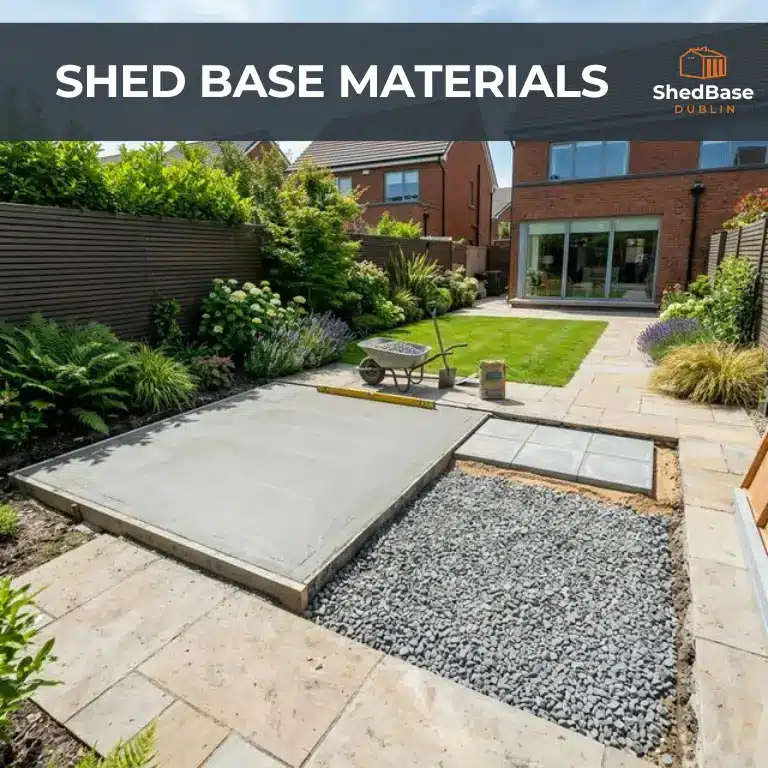
Four options. That’s it. When it comes to putting a shed base down in Dublin, you’re picking between concrete, paving slabs, gravel with a timber frame, or modular plastic panels. Everything else is a variation on one of those four.
The problem? Everyone and their mother has an opinion. Your neighbour says concrete, obviously. The lad on Reddit reckons gravel’s grand. The shed supplier is flogging plastic panel kits and swears they’re the best thing since sliced bread. And the landscaper quotes you for slabs because that’s what he’s already got on the van.
None of them are necessarily wrong. But none of them know your garden, your soil, or your shed either. So here’s an honest breakdown – no agenda, just what actually works. If you want the bigger picture on how bases work in general, our Shed Base Installation Dublin guide covers the full process.
The Quick Comparison
Before we dive in, here’s the overview at a glance:
| Material | Guide cost per m² | Durability | Install Time | Best For |
|---|---|---|---|---|
| Concrete slab | €100 – €150 | ★★★★★ | 1 day + curing | Heavy sheds, offices, workshops |
| Paving slabs | €125 – €190 | ★★★★ | 1 day | Small-medium sheds, aesthetics |
| Gravel + timber frame | €70 – €100 | ★★★ | Half day | Budget builds, sloped sites |
| Modular plastic panels | €60 – €90 | ★★★ | 2-3 hours | Small metal sheds, DIY |
Pricing update, September 2026: our paving slab bases are now €125 – €190 per m², around 25% above an equivalent poured concrete base. Slabs use more materials and every one of them is bedded and levelled by hand. The final price depends on size, ground preparation and access.
Want the full cost breakdown with real Dublin prices? Have a look at our Shed Base Cost Dublin guide.
Concrete Slab – The One That Outlasts Everything
Concrete is the heavyweight. Literally.
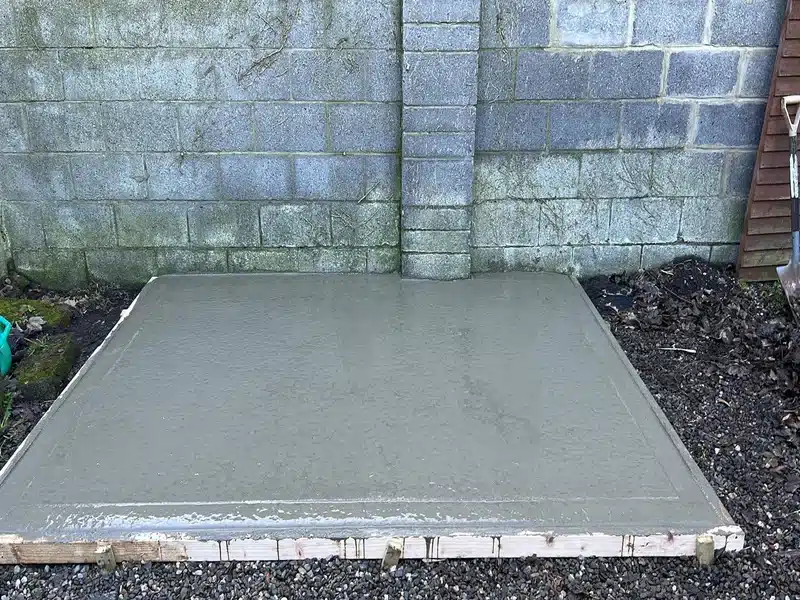
A properly poured concrete pad is the strongest, most permanent base you can stick under a garden building. Doesn’t shift. Doesn’t rot. Doesn’t flex. Once it’s cured, it’s there for decades – and it couldn’t care less whether you put a 6×4 storage shed on it or a 12×10 garden office.
How it actually works
For big sheds, garden offices, and workshops, you dig out the ground to about 200mm, lay a compacted bed of 804 hardcore (that’s the certified crushed stone that locks together when you compact it – not gravel, not pea stone, not random rubble from a skip), then slap a DPM (Damp Proof Membrane) over the top. Timber formwork goes around the edges to create a mould, then you pour C20 concrete (or C30 for heavy-duty builds) and screed it flat.
For smaller sheds? Simpler. The base can often go straight on top of the existing ground, provided it’s level and firm. No deep dig-out needed – just levelling and compaction.
Then you wait. 48-72 hours minimum before any weight goes on it. Longer in wet or cold weather – and in Dublin, that’s basically September through May.
When concrete makes sense
- Steel sheds – the DPM underneath is absolutely critical. Steel plus ground moisture equals condensation, and condensation rots everything inside. Concrete with a membrane is the only proper way around that.
- Garden offices and gyms – anything with insulation, electrics, or heating needs a rock-solid foundation. Zero tolerance for movement. None.
- Big timber sheds (10×8 and up) – a large timber structure sitting on slabs or gravel will settle unevenly. Give it two winters and you’ll see it.
The catch
Cost. Concrete costs more than gravel or plastic panels, so it’s not the budget pick. And it’s permanent – if you ever want to move the shed or reclaim the garden, you’re taking a kango hammer to it. Not exactly a relaxing Saturday.
Access is the other headache. Getting concrete into a back garden through a terraced house with no side gate means wheelbarrows through the kitchen, or a concrete pump if the garden’s tight and time is money. Either way, it adds to the bill. We see this all the time around Dublin 7, Dublin 9, and the older estates out in Fingal.
Paving Slabs – The One That Looks Good
Slabs are the go-to when you want something solid but you’re not after the full concrete treatment. Lighter on the wallet, lighter on the permanence.
How it actually works
Same basic prep: dig out, lay compacted 804 hardcore, then a layer of sharp sand on top. The slabs get laid individually onto the sand bed and tapped level with a rubber mallet. Gaps are filled with kiln-dried sand or pointed with mortar.
Thing is, the sub-base has to be done right. On firmer ground, smaller sheds can skip the full dig and go straight onto a prepared surface – but on clay-heavy soil (which is a huge chunk of Dublin), slabs need proper compacted stone underneath. The clay around North Dublin holds water, the ground softens up, and one corner drops. Then the other. Before you know it, the shed’s on a lean and the door’s catching every time you open it.
When slabs are the right call
- Smaller to mid-size sheds – 6×4 up to about 8×6. Handle the weight no bother.
- Gardens where it has to look nice – slabs are tidy, especially if you’ve already got a paved patio or path nearby. Keeps it all matching.
- If you might change your mind – slabs can be lifted individually. Pipe needs attention underneath? Grand. Want to move the shed? Take them up, no demolition required.
The catch
They’re not truly one piece. Each slab settles on its own, which means over time you can get slight unevenness – especially if the sub-base wasn’t compacted properly. For a lightweight timber shed or a small steel unit, rarely an issue. For a garden office with a floating floor inside? Worth thinking about.
And slabs don’t give you the moisture barrier that concrete with a DPM does. You can lay a membrane underneath, but it’s fiddly and not as watertight. Honestly, it’s a bit of a faff.

Gravel & Timber Frame – The Budget Option Nobody Talks About
This is the one that gets overlooked constantly. Gravel with a pressure-treated timber frame is genuinely solid when it’s done right – and it’s the cheapest of the four. By a decent margin, too.
How it actually works
You clear the area, lay a weed membrane, then pour in 20mm clean gravel to a depth of about 75-100mm. Rake it level, compact it down. Then a frame of pressure-treated 4×2 timber goes on top, creating a raised platform. The shed sits on the timber frame.
The gravel handles drainage. The timber frame lifts the shed off the ground. Together they keep moisture away from the floor joists – which is exactly what wooden sheds need to survive the Irish weather. And let’s be honest, the Irish weather doesn’t go easy on anything.
When gravel + timber is the smart move
- Wooden sheds – airflow underneath is perfect for keeping rot away. Timber sheds on timber frames. Natural pairing.
- Sloped gardens – you can build the timber frame up on one side to compensate, creating a level platform on dodgy ground. Way easier (and cheaper) than trying to level the whole area with concrete.
- Tight budget – if you’re watching the spend and don’t need something permanent, gravel and timber gets it done for less.
The catch
It won’t last forever. Timber rots eventually – even pressure-treated stuff – usually after 15-20 years, depending on how exposed it is. The gravel can shift a bit over time and might need topping up.
And forget about putting anything heavy on it. A large garden office or a big steel workshop will put too much stress on a timber frame. For anything over about 8×6 or anything with serious weight inside (gym gear, machinery), just go concrete. Don’t mess about.
Modular Plastic Panels – The Quick Fix
These are the EcoBase-style interlocking grid systems. Sheds Direct Ireland sell their own version, and they’re specifically designed for their steel shed range. Dead handy for what they are.
How it actually works
The area gets levelled, a weed membrane goes down, and the panels interlock together like giant Lego. The grid cells get filled with gravel. Shed goes straight on top.
Installation is fast – genuinely, 2-3 hours for a small base. No wet trades, no curing time, no heavy gear. The shed can go on the same day. Done and dusted.
When panels make sense
- Small steel sheds (6×4, 8×6) – they’re designed exactly for this. That’s their sweet spot.
- DIY installs – if you want to do it yourself, panels are the most forgiving option. Less precision needed compared to concrete or slabs. Hard to mess up completely.
- Rented properties – panels can be lifted and taken with you when you move. No permanent alteration to the garden. Landlord’s none the wiser.
The catch
They’re not as rigid as concrete or slabs. On soft or uneven ground, the panels can flex a bit – especially at the edges. Ground prep still matters. If the ground underneath isn’t level and compacted, the panels won’t magically fix that for you.
And for heavy sheds? No. Just no. A large timber workshop or a garden office full of furniture and people walking around needs a proper rigid base. Panels are grand for storage sheds and small steel units. That’s it.
So Which One Should You Actually Pick?
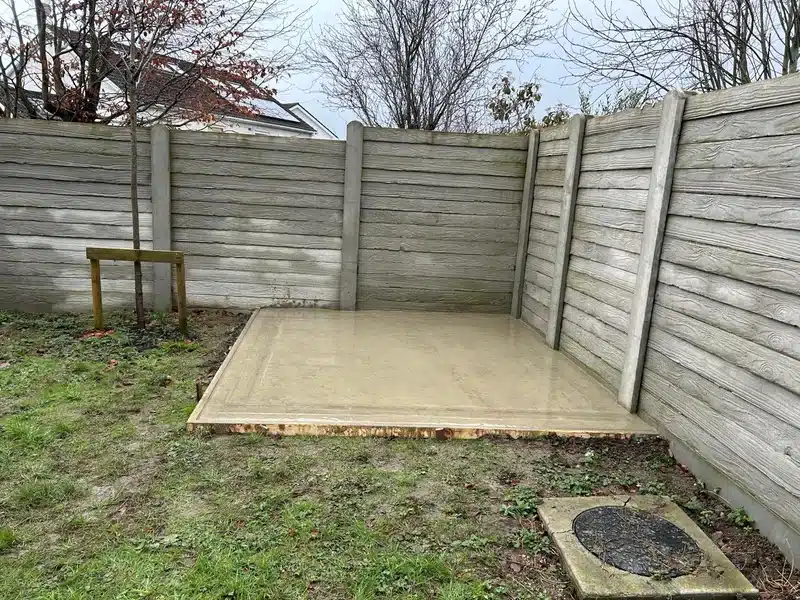
Look, it comes down to three questions:
1. What shed are you putting up?
- Steel shed – concrete (with DPM) or modular panels for small ones
- Timber shed – concrete for big, gravel/timber for small, slabs for mid-size
- Garden office or workshop – concrete. Always. No exceptions.
2. What’s the ground like?
- Clay soil (dead common around Blanchardstown, Clonee, Dublin 15) – concrete or slabs with extra sub-base depth
- Sandy or gravelly soil – any option works, gravel is especially effective
- Sloped garden – gravel + timber frame is the easiest fix by miles
3. What can you spend?
- Under €300 – gravel + timber or modular panels
- €300-€600 – paving slabs
- €500-€1,100+ – concrete
Got a small garden and trying to figure out how to make everything fit? We wrote a specific guide on small garden shed solutions that covers placement and sizing.
The Material Nobody Talks About: 804 Hardcore
Whatever base type you go for, you’ll hear us banging on about 804 hardcore (also called 804 stone or Clause 804). It deserves its own section because it’s the single most important material in any shed base – and it’s the one everyone gets wrong.
804 is certified crushed limestone containing a mix of particle sizes, from dust right up to 40mm stones. The smaller particles – the “fines” – fill the gaps between the bigger pieces and lock together when compacted. That’s what makes it a structural sub-base. Not just a pile of rocks.
What NOT to use:
 Pea gravel – round stones that roll around and never compact properly. Useless.
- Decorative chippings – look lovely in a flower bed, absolutely hopeless under a shed
- Random rubble or broken concrete – uneven particle sizes mean uneven compaction. Recipe for a sinking base.
We’ve lost count of the bases we’ve seen fail because someone used the wrong stone underneath. Looks grand for six months. Then one corner starts dropping. Always use 804. Always compact it with a whacker plate. No shortcuts, no substitutes.
Still Not Sure What to Go For?
Listen, if you’ve read all of this and you’re still scratching your head, that’s completely normal. Every garden throws up something different and the “right” answer depends on a heap of small details that are hard to judge from a webpage.
Give us a shout on 086 458 3274 or drop us a message – we’ll come take a gander at your site and tell you straight which base makes sense. No charge for the advice, no pressure to book.
For concrete specifically, check our Concrete Shed Base Dublin page. And for a full pricing breakdown, our Shed Base Cost Dublin guide has all the real numbers.