If you live in Dublin, chances are your back garden isn’t exactly a rolling meadow. Semi-ds in Dublin 15. Terraced houses in Stoneybatter. Those neat little plots out in Lucan where the fence at the back feels about six steps from the kitchen window.
And yet – you still need somewhere to chuck the lawnmower, the tools, the bikes, all the stuff that’s been cluttering up the garage (if you even have one). A shed makes sense. But the garden’s tight. Really tight.
Good news though? A small garden doesn’t mean no shed. It means a smarter shed – and more importantly, a base that’s actually designed for the space you’ve got. If you’re not sure which type of base to go for, our Shed Base Installation Dublin guide covers all the options.
 That’s a job we did in Dublin 18 back in February. Corner plot, decorative concrete fence panels on two sides, drain cover nearby that we had to work around. The base sits snugly into the corner – looks tidy, doesn’t eat into the rest of the garden, and the customer still has their full usable space back.
Works a treat. And the shed that went on top? A standard 8×6 steel unit. Nothing exotic. Just properly set up.
That’s a job we did in Dublin 18 back in February. Corner plot, decorative concrete fence panels on two sides, drain cover nearby that we had to work around. The base sits snugly into the corner – looks tidy, doesn’t eat into the rest of the garden, and the customer still has their full usable space back.
Works a treat. And the shed that went on top? A standard 8×6 steel unit. Nothing exotic. Just properly set up.
If you’re going for a 6×4, you’re genuinely looking at about 2.5 square metres. Tiny in construction terms. For small sheds like this, the base can often go on top of the existing ground – no deep dig-out needed, just levelling and preparation. The whole job can be done and dusted in a couple of hours.
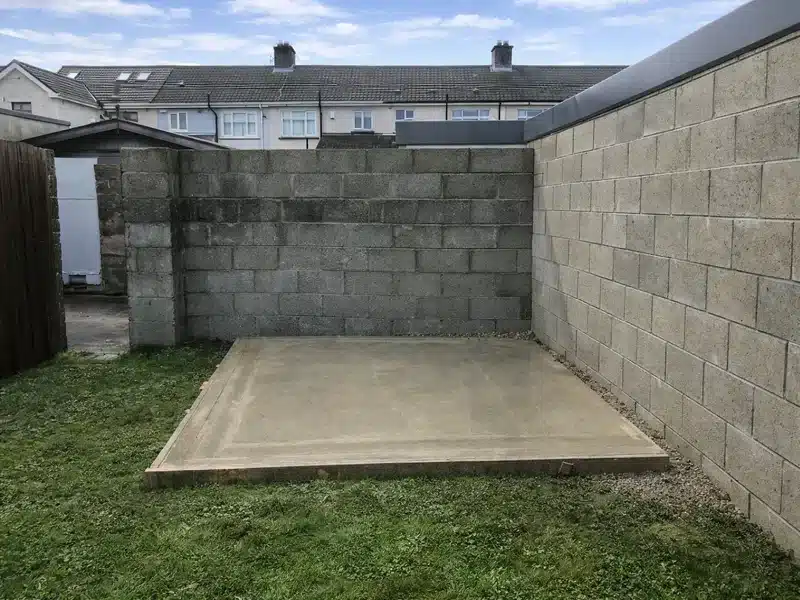 Typical Dublin back garden. Block wall on one side, grass, not a huge amount of space to play with. The customer wanted a steel shed – nothing massive, just something to clear out the garage a bit.
We prepped the corner, had a look at the existing ground, and got the base sorted. For a standard small steel shed like this, the base goes on top of the existing ground – no full dig-out, no messing about. All done in a day. The shed supplier came the following week and the whole thing slotted into place.
Total footprint? About 4.5 square metres. Barely a dent in the garden – but now there’s a proper shed there that’ll do the job for decades.
Typical Dublin back garden. Block wall on one side, grass, not a huge amount of space to play with. The customer wanted a steel shed – nothing massive, just something to clear out the garage a bit.
We prepped the corner, had a look at the existing ground, and got the base sorted. For a standard small steel shed like this, the base goes on top of the existing ground – no full dig-out, no messing about. All done in a day. The shed supplier came the following week and the whole thing slotted into place.
Total footprint? About 4.5 square metres. Barely a dent in the garden – but now there’s a proper shed there that’ll do the job for decades.
What You’re Actually Working With in a Dublin Garden
Let’s talk specifics. Most back gardens in Dublin estates built from the 1960s to the 1990s – and there’s a heap of them – are roughly 8 to 12 metres deep and maybe 6 to 8 metres wide. Take out the washing line area, the path, the kids’ trampoline, and whatever else is going on, and you’re left with a corner. Maybe 2 x 2 metres. Maybe 3 x 2.5 if you’re lucky. That’s your shed spot. Thing is, it works. A 6×4 or 8×6 shed in a corner of the garden is plenty for most people. You’re not building a warehouse. You’re building somewhere dry to keep the garden tools, the paint tins, the Christmas decorations – all the stuff that doesn’t have a home inside the house. But – and this is the bit people underestimate – the base under a small shed still has to be right. Smaller doesn’t mean less important. Actually, in some ways it’s trickier. You’ve got less room for error when you’re working in a tight corner right up against the boundary wall.Corner Spots: Why They’re Actually Grand
Most small sheds end up in a corner. Back wall on one side, side fence on the other. People worry about that – feels cramped, feels like there won’t be enough airflow, feels like it’s going to look squeezed in. In practice? A corner is one of the best spots for a shed. Full stop. Two sides are already “walled” – that’s two less sides the wind and rain can wallop. Natural shelter. For a steel shed especially, having the back and one side protected cuts down the amount of moisture getting driven into the joints. Less moisture, less condensation, longer life. Simple as that.
That’s a job we did in Dublin 18 back in February. Corner plot, decorative concrete fence panels on two sides, drain cover nearby that we had to work around. The base sits snugly into the corner – looks tidy, doesn’t eat into the rest of the garden, and the customer still has their full usable space back.
Works a treat. And the shed that went on top? A standard 8×6 steel unit. Nothing exotic. Just properly set up.
Picking the Right Base Type When Space is Tight
When you’ve got limited room, the base type matters more than you’d think. Here’s how the options stack up for compact gardens:Concrete Slab
Still the gold standard, even for small sheds. A concrete pad gives you the most solid, permanent foundation going. It’s the obvious choice if you’re putting a steel shed in a damp corner – which, let’s face it, in Dublin that’s most corners. Catch in a small space? Concrete needs formwork boards around the edges, which means you need a few inches of clearance beyond the actual base dimensions. If you’re right up against a wall, it’s doable – just needs a bit of planning beforehand. For a full breakdown of what concrete costs, check our Shed Base Cost Dublin guide.Paving Slabs
Great for small sheds. You can lay them tight into a corner without needing extra clearance for formwork. They look neater too – especially if the rest of your garden has a paved area nearby. And down the line, they’re easy to lift if you ever need to get at a pipe or cable underneath. The catch? On softer or clay-heavy ground, you’ll want a properly prepared sub-base – sand and compacted 804 hardcore underneath. That said, for small sheds on firm, level ground, slabs can often go straight onto the existing surface without full excavation. Your installer will take a look on the day and tell you what’s needed.Modular Plastic Panels
The EcoBase-style grid systems from Sheds Direct Ireland are built specifically for this. Quick to lay, lightweight, interlock without any wet trades. For a small metal shed on a reasonably flat site? Honestly, it’s the fastest option going. But. The ground underneath still needs to be level, compacted, and membrane-covered. The panels aren’t magic – they’re only as good as the prep work beneath them. Skip the groundwork and you’re wasting your money.Gravel & Timber Frame
This one’s interesting for small gardens because the timber frame creates a slightly raised platform. Grand for drainage – especially when you’re in a corner where water sometimes pools against the boundary wall. The raised edge also helps with airflow under a wooden shed, which keeps rot at bay. Not as permanent as concrete, and the timber needs to be pressure-treated to handle the Irish damp. But for a budget-friendly small shed? It does the business. For a deeper comparison of all four base materials, have a look at our shed base materials guide.Placement Tips – Getting the Most From a Tiny Garden
A shed that’s badly placed in a small garden sticks out like a sore thumb. One that’s well placed kind of disappears – in a good way. Here’s what we’ve picked up from doing this across Dublin for the last twenty-odd years.Tuck It Into a Corner
Already said it. Worth saying again. Corner placement frees up the maximum amount of usable garden space. The shed becomes part of the boundary rather than something plonked in the middle of the lawn.Think About Where the Door Swings
This is the one people forget. Every time. If your shed door opens outward (and most do), you need clearance in front of it. Obvious when you think about it. But in a small garden, that clearance is garden you can’t use for anything else. Orient the door so it opens toward the least-used part of the garden. Or have a word with the shed supplier about a sliding door option – takes up zero swing room.Check for Drain Covers
Dublin gardens are absolutely littered with manhole covers and inspection chambers. You can’t build over them – well, you shouldn’t. And any competent base installer will tell you the same thing. We’ve done loads of jobs where the shed position had to shift 300mm to the left because there was a chamber nobody noticed until we started work. Check first. Saves a serious headache.Don’t Forget You Need to Actually Get to the Shed
Sounds silly. It isn’t. If you’ve squeezed the base right into the back corner and left a six-inch gap between it and the fence, you’ll be climbing over things to get the lawnmower out. Every. Single. Time. Leave a reasonable path – even 400mm on one side – and you’ll thank yourself every time it’s lashing rain and you’re wrestling tools out in your slippers.What Size Base Do You Actually Need?
The base should be the same size as the shed – or ideally, 50mm larger on each side. That gives the shed a “shelf” to sit on and stops the edges from hanging over into the soil where moisture can creep up. For the most common small shed sizes:| Shed Size | Base Size (with 50mm overhang) | Area |
|---|---|---|
| 6×4 ft (1.8 x 1.2 m) | 1.9 x 1.3 m | ~2.5 m² |
| 8×6 ft (2.4 x 1.8 m) | 2.5 x 1.9 m | ~4.7 m² |
| 10×6 ft (3.0 x 1.8 m) | 3.1 x 1.9 m | ~5.9 m² |
Planning Permission: The Small Garden Advantage
Planning permission, updated 9 August 2026. Since 27 July 2026 you can build a shed of up to 30 m² at the back or side of your house without planning permission, up from 25 m². You still have to leave at least 25 m² of private open space, and height limits apply. In a small garden it is usually the open space rule that limits you, not the 30 m². See the full planning rules for sheds in Dublin.
And if your garden backs onto a protected structure, a riverbank, or an area with specific development restrictions, the rules can be tighter. Rare in suburban Dublin, but worth knowing.A Real Example: Dublin 18, February 2026
One more look at this job, because it’s a perfect example of what we’re on about.
Typical Dublin back garden. Block wall on one side, grass, not a huge amount of space to play with. The customer wanted a steel shed – nothing massive, just something to clear out the garage a bit.
We prepped the corner, had a look at the existing ground, and got the base sorted. For a standard small steel shed like this, the base goes on top of the existing ground – no full dig-out, no messing about. All done in a day. The shed supplier came the following week and the whole thing slotted into place.
Total footprint? About 4.5 square metres. Barely a dent in the garden – but now there’s a proper shed there that’ll do the job for decades.