
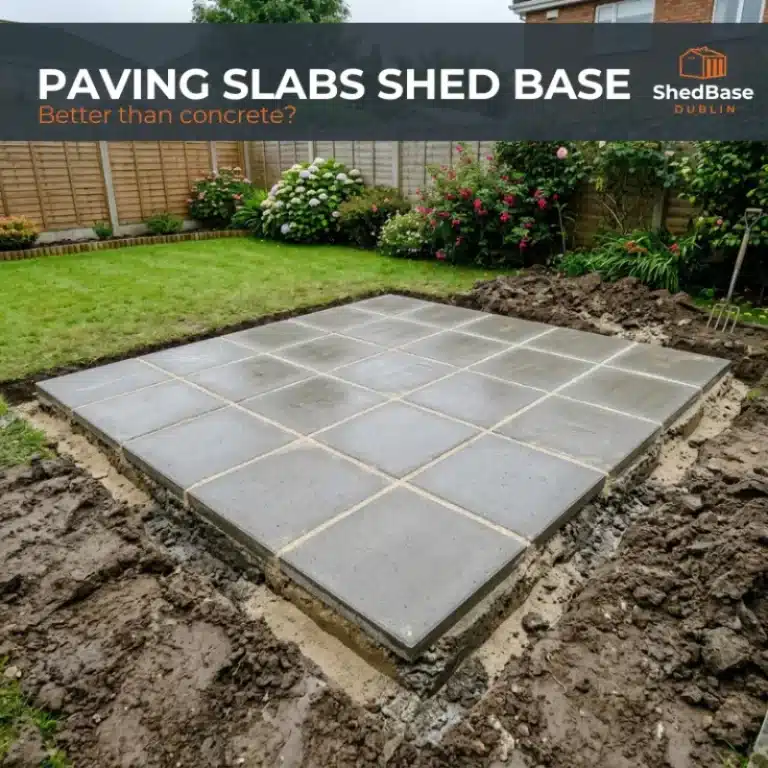
Paving Slabs for a Shed Base in Dublin - A Guide to When Slabs Are Better Than Concrete for 2026
One of the main questions we get asked by customers looking for a shed base is whether they really need to go to the expense of a poured concrete pad or if simple paving slabs will do the job just fine.
From our experience putting in bases all over Dublin, paving slabs can actually make a brilliant foundation for a shed – provided that you use them in the right type of garden for the right type of shed.Â
If you try to cut corners with slabs you’ll just end up with a shed that starts sinking and leaning before the end of the year, but if you do the groundwork properly they can give you a foundation that looks much nicer in a garden setting and will last you for years with a finish that suits the rest of the garden.
When it comes to prices for a paving slab shed base in the Dublin area you’re generally looking at somewhere between €125 and €190 per square metre, which includes all the materials and our labour. That is around 25% above an equivalent poured concrete base, because slabs use more materials and every one of them has to be bedded and levelled by hand.
So if you were getting a standard 2.4m x 1.8m (8ft x 6ft) shed, around 4.3 m² of ground, you would expect to pay roughly €540 to €820 in total – though that can change a bit depending on how good the access to your garden is and what the soil is like when we start digging.
Why We Often Recommend Slabs Instead of Concrete
We do a huge amount of poured concrete bases and they are obviously the strongest option available, but we don’t think they are always the right choice for every single garden.
The main issue with concrete is that it’s completely permanent and once we pour it you can’t really move it. If you decide a few years down the line that you want to move the shed to the other side of the garden or if you need to run a new drainage pipe through the lawn then you are stuck with a massive grey concrete block right in the way and breaking that up is a very expensive and messy job.
Paving slabs give people a lot more flexibility because they can just be lifted up one by one if there’s ever a problem with pipes underneath, or you can even lift the whole lot and relay the base in a completely different part of the garden.Â
We also find that a lot of people just prefer the look of paving slabs because they blend into the rest of the landscaping much better than a slab of grey concrete does.
We generally tell customers that slabs are the better choice if:
- They are getting a small or medium sized shed – up to about 3m x 2.4m (10ft x 8ft) is perfectly fine for most timber sheds or the lighter steel storage sheds
- They care about how the base looks in their garden and don’t want an industrial looking foundation
- They think they might want to change their garden layout in the future
- Their garden is already fairly level without any steep slopes
If you have ordered a very heavy garden office or something bigger than about 5 square metres then we would always say to go with concrete instead to be safe, and you can read more about that on our concrete shed base page.
How We Actually Build a Proper Paving Slab Base
A lot of people think you can just buy some slabs from a garden centre and lay them straight onto the grass before putting the shed on top, but that’s a mistake we see all the time and it guarantees that your shed doors won’t close properly after a few months because the ground underneath will shift.
The way we do it is much more involved to make sure the base stays level for years to come.
First we have to measure out the footprint of the shed and add about 50-75mm extra around the edges before we start digging the ground out. We work a lot in places around Blanchardstown and Mulhuddart where the soil is very heavy clay and because of that we have to make sure we dig down deep enough to allow water to drain away properly so you don’t end up with a bog underneath your shed floor.
After we dig everything out we put in the sub-base which is probably the most important part of the whole job – we use heavy 804 hardcore across the whole dug out area and then we use a mechanical whacker plate to compact it all down until it goes totally solid. If anybody tries to build a slab base without this compacted hardcore layer the slabs will definitely end up sinking over time.
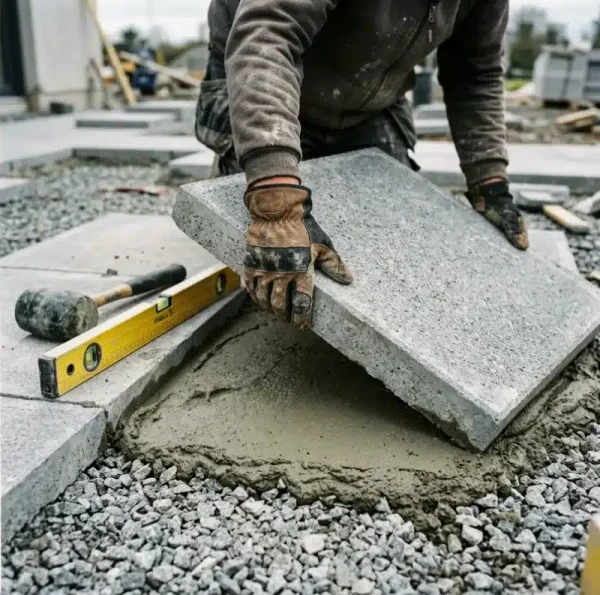
Once the sub-base is locked in, we spread a semi-dry mortar mix on top of it and then we lay every single slab on that mortar bed while using a rubber mallet and a spirit level to make sure everything is perfectly flat across the entire area.
We prefer to use 600mm x 600mm heavy utility slabs because they distribute the weight really well and we leave very small gaps between them which we then brush kiln-dried sand into so the whole structure locks together and stops weeds coming up through the base.
Usually we can get a standard size base finished in just a single day and because there is no wet concrete involved there is no curing time, so the shed installers can come out the very next day and put your shed up straight away.
Dealing with Dampness and Damp Proof Membranes
We put a thick plastic Damp Proof Membrane (DPM) under every concrete base we pour, but when it comes to paving slabs the rules are a bit different and it really depends on what kind of shed you are getting.
If you are buying a steel shed then we would definitely lay a heavy-duty polythene sheet over the compacted hardcore just before we put the mortar bed down. Steel sheds get very cold in the winter and if you don’t have that barrier the condensation can rise up through the ground and cause real problems inside.
If you are getting a timber shed you don’t usually need a membrane built into the actual slab base because the shed itself will sit on wooden bearers which keep the floor raised off the ground and let air flow underneath to stop damp build up. The only exception we make is if we’re working in a garden out in lower lying areas like Swords or certain parts of North Dublin where the ground stays very wet all winter, and in those cases we suggest putting an extra membrane in anyway just to be totally safe.
The Costs for a Paving Slab Base Around Dublin
To give you an idea of what people are paying in 2026, here is roughly how the costs break down between a paving slab base compared to a poured concrete base.
| The Size of Your Shed | The Total Ground Area | Our Cost for a Paving Slab Base | Our Cost for a Concrete Base |
|---|---|---|---|
| 6ft x 4ft (1.8m x 1.2m) | Around 2.2 m² | Between €275 and €420 | Between €220 and €330 |
| 8ft x 6ft (2.4m x 1.8m) | Around 4.3 m² | Between €540 and €820 | Between €430 and €645 |
| 10ft x 8ft (3m x 2.4m) | Around 7.2 m² | Between €900 and €1,370 | Between €720 and €1,080 |
Slabs work out around 25% more than an equivalent poured concrete base. Each slab has to be bedded and levelled individually and there are more materials involved, which is where the extra cost goes. The final price depends on size, ground preparation and access.
The only thing to keep in mind is that our final price has to factor in how easy it is to get materials into your garden. If you live in an older terraced house in an area like Cabra or Phibsborough where we have to carry tonnes of broken stone through your front door and out the back kitchen door, the job just naturally takes a lot longer and costs a bit more than a modern house with a wide side gate.
If we hit very heavy clay soil – which happens to us all the time in places like Dublin 15 or Clonsilla – we sometimes have to dig deeper and bring in extra hardcore to make sure the base is properly stabilised, which can add maybe 10-15% to the final quote.
An Example Job We Completed Recently for a Timber Shed
Just recently we did a slab base over in Castleknock for a customer who was getting a quite nice 10ft x 8ft timber shed delivered and she had a nice flat garden with really good access through a side gate.
We suggested concrete originally but she specifically wanted us to use paving slabs instead because it was a landscaped garden and she hated the idea of having a large grey block sitting there ruining the look of her lawn.
Because the subsoil was just heavy clay we had to dig a trench about 200mm deep and fill it with 150mm of 804 hardcore which we compacted down completely flat before we set twenty heavy paving slabs on top of a mortar bed, and we put a damp membrane under the mortar just to be extra careful with the clay soil.
The whole job took us about six hours from start to finish and all the rubbish was cleared away before the shed suppliers arrived two days later to build the actual shed.
On our current pricing a job like that comes to about €1,190 altogether, labour, materials and vat included, whereas the poured concrete alternative for the same footprint would have been over €950.
When We Tell People Not to Use Paving Slabs
To be completely upfront we don’t always recommend paving slabs because sometimes they are just the wrong choice depending on what you are building.
If you are planning to build a large outdoor garden office or a home gym full of heavy weights then we will tell you not to use slabs at all because the heavy concentrated weight can cause individual slabs to shift over time, so for heavier structures concrete is the only way to go.
The same rule applies if your garden is very hilly or sloping because it is incredibly difficult to build a lasting slab base on a steep slope without the ground moving later on, whereas concrete can be shuttered and poured to follow a slope while still giving you a flat top surface for the shed.
We also advise people not to use slabs if their base area is huge – anything much bigger than 10 square metres has so many individual slabs that something will inevitably settle differently eventually, so a solid concrete slab makes much more sense.
You can read our full shed base materials guide to see exactly how slabs compare against everything else if you are still trying to make your mind up.
How to Get in Touch
If you need some advice on what kind of base would work best for your new shed we are happy to do free consultations and give you a quote without any hassle.
You can give Zim a ring directly on 086 458 3274 to discuss your garden, or if you prefer you can use our contact form and we will get back to you to arrange a time to visit.
Planning a new shed or garden room? Start with a foundation you can trust.
Contact us today
Some Common Questions About Paving Slab Bases
Can I just use any type of paving slabs for my shed base?
You shouldn’t really use just any slab because thin, cheap decorative ones you find in garden centres can actually crack quite easily under the weight of a busy shed. We always tell people to use heavy duty 600mm x 600mm concrete paving slabs that are at least 50mm thick because they are built purely to take heavy loads without cracking up, and standard grey utility ones are usually perfect for this sort of job.
Do the paving slabs actually need all that hardcore sub-base underneath them?
Yes, they absolutely do – and this is actually the biggest mistake we see from people trying to build their own bases at the weekend. If you leave out the compacted crushed stone your shed will definitely sink unevenly once the winter rain comes because it is the 804 hardcore sub-base that takes all the physical weight of the structure while the slabs just give you the clean flat floor on top to work with.
How many years will a paving slab shed base last in a typical garden?
When the job is done correctly you should easily get 15 to 20 years out of a good slab base and often much longer than that because the heavy concrete slabs don’t rot. The only reason a slab base ever fails is if the ground underneath it shifts or washes away, which just proves why the compacted hardcore layer is the most important part of the entire process.
Is it possible to lay the paving slabs and build a base myself?
It is definitely possible if you are able for the heavy physical digging and lifting, but you do need to make sure you hire a proper mechanical whacker plate and arrange a delivery of structural 804 stone rather than just buying bags of pea gravel. You also need to be extremely careful with your spirit level because if the finished surface isn’t perfectly flat your new shed won’t line up properly when it comes to screwing the panels together.
Do paving slabs cost more than a poured concrete base?
Yes. A paving slab base runs about €125 to €190 per square metre, around 25% above an equivalent poured concrete base. Slabs use more materials and each one is bedded and levelled individually. The final price depends on size, ground preparation and access, so compare quotations for the same footprint and specification.
What do I do if one of the slabs cracks after a few years?
That is actually the main hidden benefit of having a slab base in the first place – if a stone happens to break years from now you can just dig that specific slab out, put some fresh mortar down and drop a new slab straight back into the hole. If a concrete base cracks it is a massive job to patch or repair it properly but slabs mean you have a lot of flexibility going forward.
Create Your Dream Garden with ShedBase Dublin!
Looking to add a durable, stylish garden shed (or a full garden room setup) with the right foundation? Our expert team specialises shed base installation across Dublin – tailored to your space, your needs, and your budget. Whether you need a concrete base, slabs, or a gravel timber frame, we’ll deliver a level, long-lasting finish that keeps your building stable for years.
📞 Call us at 086 458 3274
📧 Email us at [email protected]
Don’t wait – your new shed (and the perfect base) is just a call or click away!