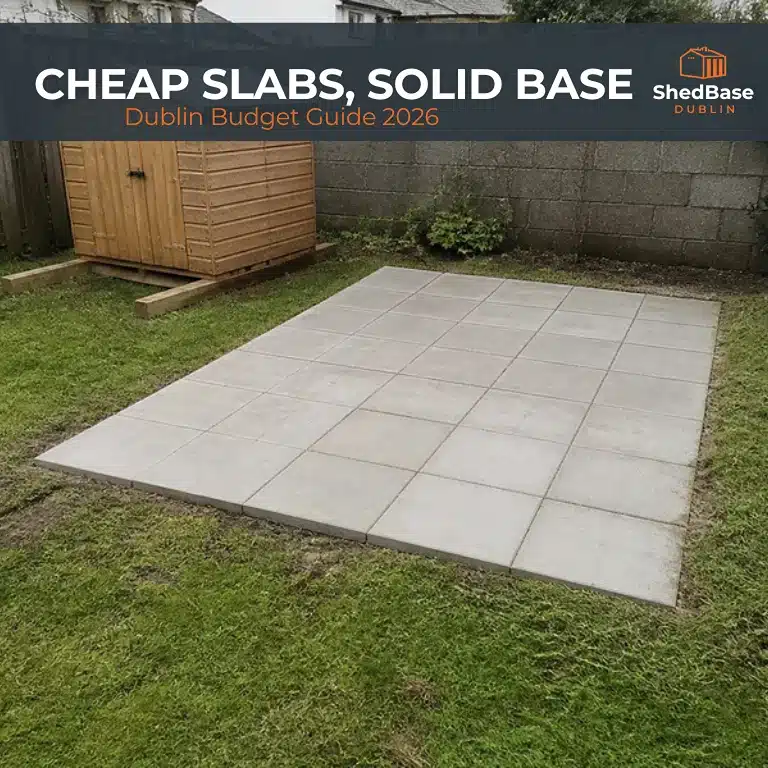
One of the most common conversations we have with customers is some version of this: “I’ve seen cheap paving slabs at the builders merchant, would they do for under the shed?” And the honest answer, most of the time, is yes. A shed base is not a patio. Nobody is going to be admiring it once the shed’s sitting on top, and the slab itself doesn’t need to be pretty to do its job.
A budget paving slab shed base in Dublin comes in at €125-€190 per square metre installed, whatever slab you go for. That is around 25% above an equivalent poured concrete base, because every slab has to be bedded and levelled by hand. For a standard 2.4m x 1.8m (8ft x 6ft) shed, that works out at roughly €540-€820 all-in – though the final figure always depends on the size, how much ground preparation is needed, and the access into your garden.
And let’s be straight about something before we go any further, because plenty of people assume slabs are the bargain way to build a base. They’re not. Laying slabs is slower, fiddlier work than pouring concrete – every slab bedded on full mortar, levelled by hand, jointed – so a slab base actually costs more than a concrete pad, not less. If rock-bottom price is the whole brief, gravel is your man, with concrete second. What’s cheap here is the slab itself.
But here’s the thing, and it’s the whole point of this article. The slab is the cheapest part of the job. The bit that decides whether your base is still level in ten years is everything underneath it. Save money on the slab all you like – just don’t let anyone save money on the groundwork.
Why Cheap Slabs Are Usually Grand Under a Shed
Think about what a shed base actually has to do. It spreads the weight of the shed evenly, keeps the floor up off the wet ground, and gives you a level surface so the doors open properly. That’s it.
A patio has a harder life, believe it or not. Patio slabs get walked on daily, get furniture dragged across them, need to look well in the middle of the garden. Shed base slabs? They get covered by a shed within a week of being laid and spend the next twenty years in the dark.
So the qualities you’re paying extra for with premium slabs – the colour consistency, the fancy riven finish, the natural stone look – are wasted under a shed. What you actually need is thickness and a sound sub-base. A 50mm thick budget concrete slab on properly compacted 804 hardcore (that’s the certified crushed stone with fines that bind when compacted) will outperform a fancy 30mm porcelain tile on a bad base every single time. Utterly no contest, if you ask me.
We covered the full slab base build on our paving slabs shed base page – this article is about squeezing the cost down without wrecking the result.
The Budget Slab Options Worth a Look
Here’s what you’ll actually find at builders merchants around Dublin, roughly from cheapest up.
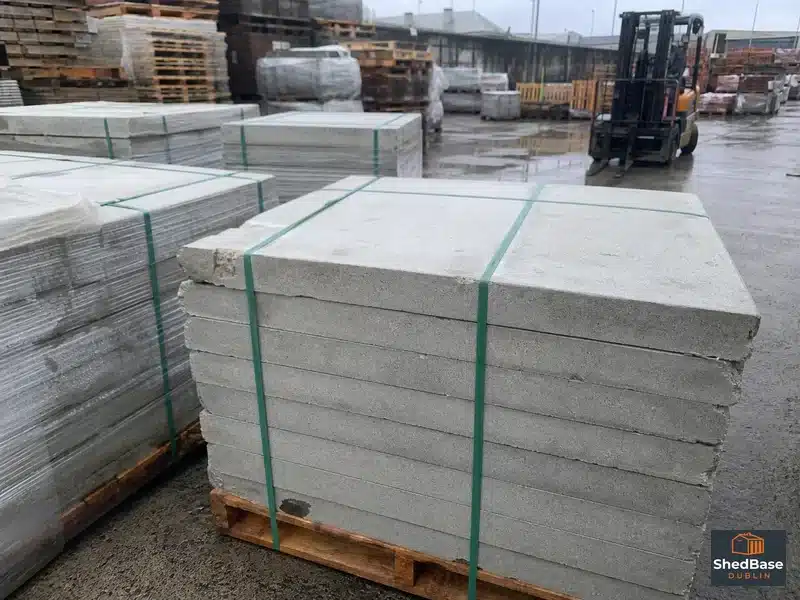
- Wet-cast concrete slabs – the classic grey 600mm x 600mm flag. Boring as anything. Won’t win any design awards, but it works, and it’s the cheapest proper slab you can buy.
- Pressed concrete flags – the footpath-style slab. Dense, strong, made to be driven over in some grades. A heap less money than natural stone and honestly ideal under a shed.
- Budget-grade Indian sandstone – if you want the base to look decent while the shed’s small enough to leave some slab showing. The cheaper grades are fine for this. For the full natural stone story, take a gander at our sandstone vs limestone comparison.
- Seconds and end-of-line packs – merchants sell off discontinued lines and slightly imperfect slabs at a good discount. Chipped corners and colour variation don’t matter one bit under a shed. Ask at the trade counter, because these are rarely on display.
- Reclaimed slabs – free or nearly free if you know someone lifting an old patio. Usable, with two caveats: they need to be the same thickness as each other, and you need enough of them. Mixed thicknesses make levelling a nightmare.
One thing we’d steer you away from: the very thin 30-35mm “patio pack” slabs that show up in summer promotions. They’re priced to move and they look like a bargain. Under a point-loaded shed floor on anything less than a perfect bed, they crack. Wrong tool for the job.
What a Budget Slab Base Costs in Dublin (2026)
Guide figures for a standard 2.4m x 1.8m (8ft x 6ft) shed base, materials and labour included. Treat these as a starting point, not a quote – ground preparation and access are the two things that move the price, and every garden is different.
| Option | Guide cost per m² | Total for 8×6 base | Best for |
|---|---|---|---|
| Wet-cast concrete slabs | €125-€190 | €540-€820 | The pure budget job. Solid, grey, invisible under the shed |
| Pressed concrete flags | €125-€190 | €540-€820 | Heavier sheds, best strength for the money |
| Budget Indian sandstone | €125-€190 | €540-€820 | When some of the base stays visible |
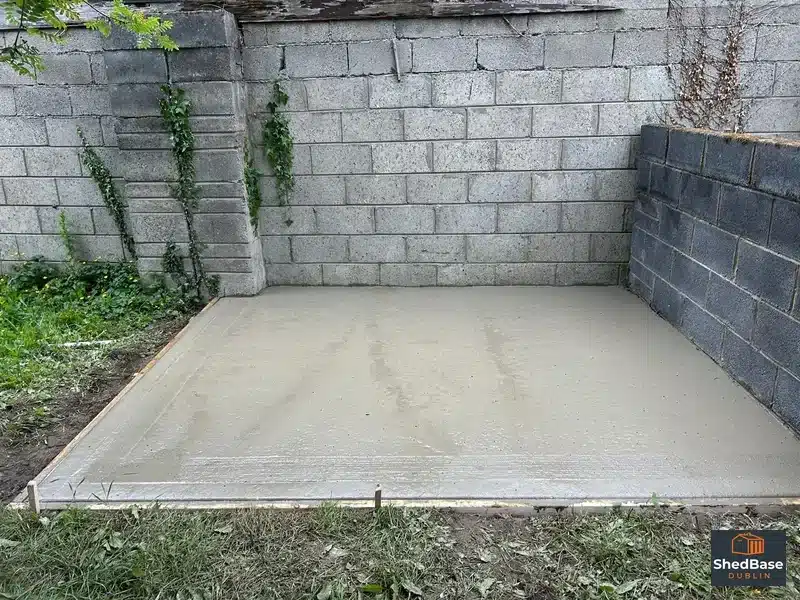
| (Reference: poured concrete pad) | €100-€150 | €430-€645 | Heavy sheds, garden offices, workshops |
| (Reference: stabilised gravel base) | €60-€90 | €260-€390 | The cheapest base of all – different build entirely |
One range for all three slab rows, and that’s deliberate. The groundwork and the laying are identical whichever slab you pick, and they’re most of the money – the slab itself only decides where in that range you land. Wet-cast at the bottom, budget sandstone at the top. Across the range it lands around 25% above an equivalent poured concrete base.
Notice the two reference rows while you’re at it. If the budget is genuinely tight and the shed is a light timber one, a stabilised gravel base undercuts every slab option by a distance – and even a poured concrete pad normally comes in under slabs, because one pour is less labour than bedding slabs one at a time. Slabs earn their extra cost with a cleaner finish, a firmer floor feel, and the option of lifting and re-laying the odd slab years down the line. And if you want the complete price picture across every base type, our shed base cost guide breaks it all down.
Where Cheap Goes Wrong
Right. This is the important section, because we get called out to fix a few of these every year.
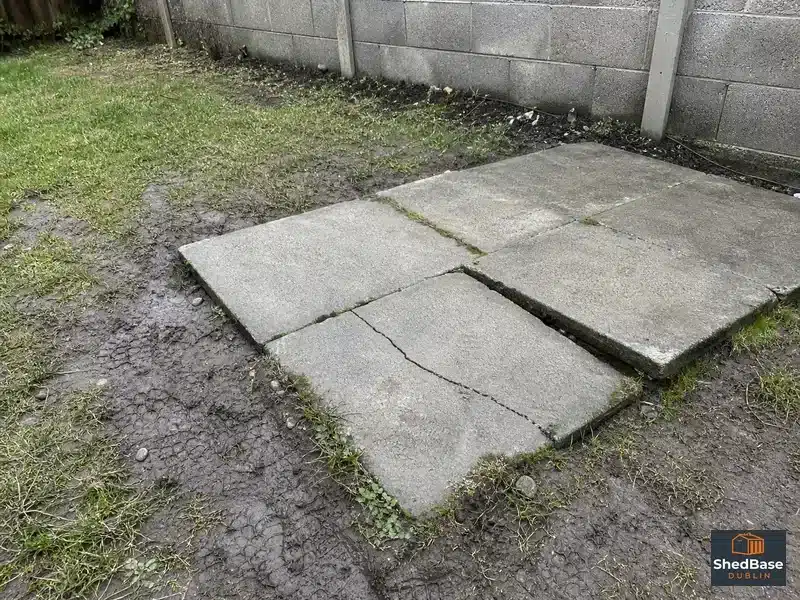
Cheap slabs on no sub-base. Someone lays slabs straight onto grass or a skim of sand, and it looks fine on day one. Then the Dublin rain does what it does – Met Eireann counts around 150 wet days a year here, you can check the monthly numbers yourself – and the ground under the slabs softens and moves. Within a winter the base is rocking, the shed doors are catching, and the whole thing has to come up. All that money saved on slabs, spent twice on the redo.
Dot-and-dab bedding. Blobs of mortar under the corners of each slab instead of a full bed. Faster and cheaper to lay, and completely wrong for a base that carries a shed. Slabs need full support or they crack across the middle when the weight lands on them. So the slab was cheap, and then the shed floor sagged, and now the slab is cracked. You see how this goes.
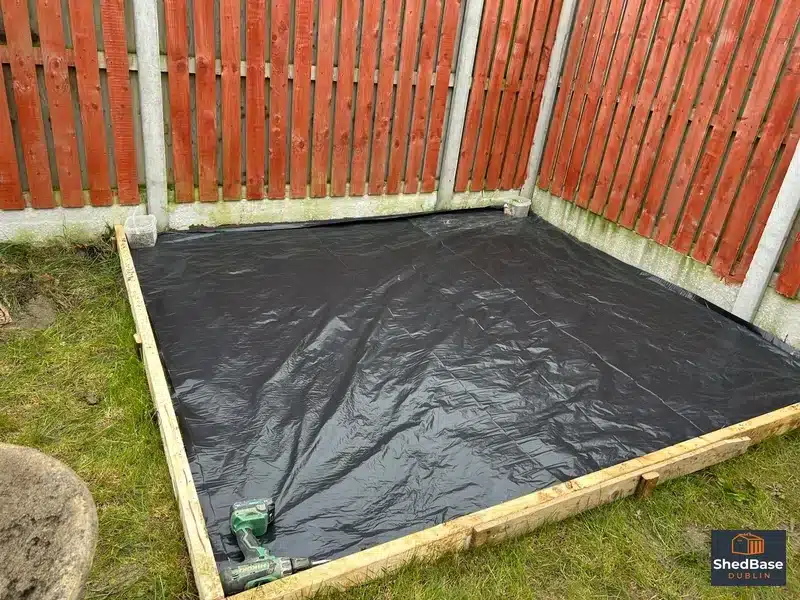
Skipping the DPM under a steel shed. A DPM (Damp Proof Membrane) is the polythene moisture barrier that goes in below the bedding layer. Steel sheds pull condensation something fierce without one. It costs very little as part of the build. Leave it out and everything you store in the shed smells of damp by Christmas.
Mixed thickness slabs. Usually from combining leftover packs or reclaimed slabs from two different patios. Each slab needs its own bedding depth adjusted, the levels wander, and the labour cost goes up by more than the slabs saved. Fine if it’s one consistent batch. False economy otherwise.
The pattern in all of these? The failures are never really about the cheap slab. It’s the corners cut underneath.


How We Build a Budget Slab Base
Same five steps as a premium slab job, because the build is not where we cut corners. Excavate, compact a 100-150mm sub-base of 804 hardcore (deeper where we hit the heavy clay you get around North Dublin), lay the DPM where the shed type calls for it, bed the slabs on a full mortar bed, and joint them. The full process is on our shed base installation guide.
Most jobs are done and dusted in a day. We also build the base about 50mm larger than the shed footprint all round – standard practice, gives the shed a bit of tolerance for positioning.
And listen, if you’ve already bought slabs yourself, or you’ve spotted a seconds pack going cheap – that’s genuinely fine by us. You supply the slabs you want, we make sure what’s under them is right. That’s the arrangement that gets you a cheap base that lasts, rather than a cheap base that becomes an expensive one.