
Huntstown, Dublin 15, D15 WY81

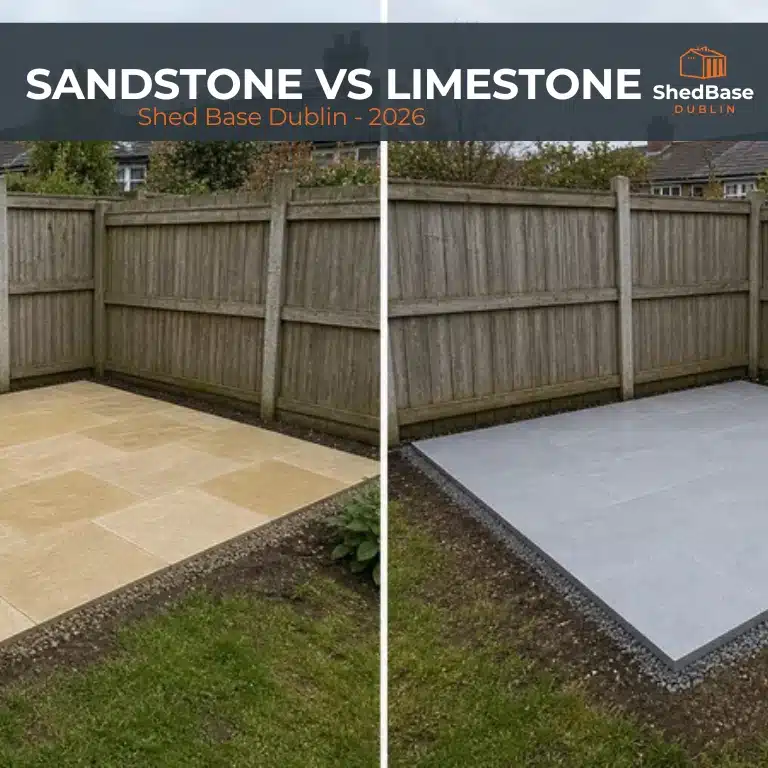
Sandstone vs Limestone Shed Base - Which Material for Your Dublin Garden? (2026)

Table of Contents
sandstone vs limestone shed base dublin

If you’re looking at a natural stone shed base for your Dublin garden, the choice almost always comes down to two materials. Sandstone or limestone. Both look brilliant. Both cost more than concrete or basic paving slabs. And both behave very differently in Irish weather over a 10-15 year span.

A natural stone shed base in Dublin typically costs between €130 and €190 per square metre including the sub-base, bedding, and labour. Limestone usually sits at the lower end, sandstone at the upper end. For a standard 2.4m x 1.8m (8ft x 6ft) shed, you’re looking at roughly €560 to €820 all-in. Pricier than concrete, miles nicer to look at.

Here’s the thing nobody tells you upfront. The choice between these two stones isn’t really about looks – it’s about how they handle damp, frost, and the kind of foot traffic you’ll have around the shed. Let’s get into it properly.

What’s the Actual Difference Between Sandstone and Limestone?

Quick geology lesson. Both are sedimentary rocks. Both were laid down over millions of years from compressed material. After that, they’re different beasts entirely.

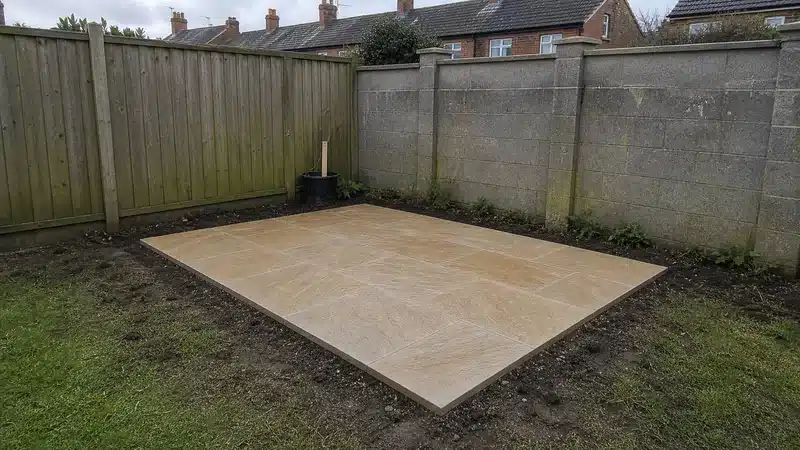
Sandstone is made from compressed sand grains – mostly quartz – bound together by silica or iron oxide. It’s slightly porous. Has a textured, sometimes riven surface. The colour palette runs from buff and golden through to deeper reds and browns. Mint Indian sandstone, Raj green, autumn brown – all popular in Dublin gardens.

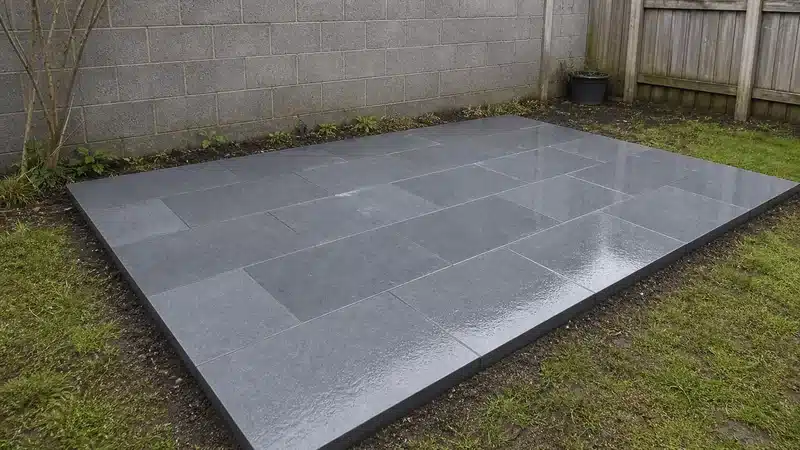
Limestone is made from compressed marine sediment – mostly calcium carbonate, often with fossil traces visible in the slab. The surface tends to be smoother and more uniform. Colour-wise you’re mostly in the grey-blue-black range, occasionally with hints of brown. Kilkenny limestone is the proper local stuff, Irish blue limestone the trade name you’ll see most often.

Both come as paving slabs in standard sizes – typically 600mm x 300mm, 600mm x 600mm, or random pattern packs. For a shed base, you’re laying them on a proper sub-base, bedded in mortar or sharp sand, then jointed with kiln-dried sand or a mortar pointing. The build process is similar to what we cover on our paving slabs shed base page.
mint indian sandstone shed base dublin

How They Handle Irish Weather

This is the bit that actually matters. Met Eireann gives Dublin around 150 wet days a year – if you want the actual numbers, the Met Eireann monthly climate data breaks it down properly. Any stone going under a shed has to deal with constant damp, hard frosts in January and February, and the freeze-thaw cycle that follows.

Sandstone behaviour in Dublin:

  • Slightly porous – absorbs water more readily than limestone.
  • Can darken visibly when wet, then dry back to its original colour.
  • Some softer Indian sandstones can spall (surface flakes off) after repeated freeze-thaw if water gets in. Mint and Modak grades are pretty robust though.
  • Develops a weathered patina over a few winters that most people actually like.
  • Surface stays grippier when wet – the textured face gives decent footing.

Limestone behaviour in Dublin:

  • Denser. Lower porosity. Handles freeze-thaw better than most sandstones.
  • Can develop a chalky white efflorescence in the first 6-12 months as the natural salts work out. Brushes off, no harm done.
  • Smoother surface gets seriously slippy when wet. Worth noting if you’re stepping in and out of the shed in winter.
  • Kilkenny limestone in particular ages beautifully – goes from a fresh blue-grey to a deeper, almost silvery tone.
  • More uniform colour means fewer surprises when you order a fresh pack 5 years later.

So if you’re after the lowest-maintenance long-term option, limestone usually edges it. But that slippiness when wet is a real consideration – especially if you’re stepping in and out in muddy wellies during a wet Dublin winter. Some customers end up adding a small rubber mat at the shed door, or specifying a textured rather than honed finish for the slabs nearest the entrance. Worth thinking about before you commit to a smooth-finish limestone for the full base.
irish blue limestone shed base castleknock

Cost Comparison – Sandstone vs Limestone in Dublin

Real Dublin pricing, for a standard 2.4m x 1.8m (8ft x 6ft) shed base, materials and labour all-in. Treat these as a guide, not a fixed quote – the single biggest variable on any natural stone base is how much ground preparation the garden needs. A flat, firm, accessible plot sits at the lower end; soft ground, a slope, or a dig-out that needs extra sub-base work pushes the figure up.

MaterialCost per m²Total for 8×6 baseLifespanMaintenance
Indian sandstone (Mint, Raj green, autumn brown)€130-€160€560-€69015-20 yearsRe-joint sand every 3-5 years
Irish blue limestone€150-€190€650-€82020-25 yearsBrush off efflorescence year 1, re-joint every 5 years
Kilkenny limestone (premium)€170-€210€730-€91025+ yearsMinimal – it just ages well
(Reference: standard concrete pad)€100-€150€430-€64520+ yearsNone

So you’re paying a clear premium over concrete, around €100-€300 more depending on stone choice – and that’s before any extra ground preparation the site might call for. Where the cost makes sense is when the shed is a garden feature in its own right – a summerhouse, garden office, hobby studio. For a basic tool shed at the back of the garden? Concrete or a stabilised gravel base does the same job for less.

When Sandstone Is the Right Call

Honest answer? Sandstone wins on three specific fronts.

Warmer-toned gardens. If your house has a buff brick, a beige render, or natural timber cladding around the back, sandstone slabs in the buff-to-autumn-brown range tie the whole garden together. Limestone’s cool grey-blue can feel cold against warm building materials.

Where you need grip. The slightly textured, sometimes riven surface of sandstone holds its grip when wet far better than smoother limestone. Worth thinking about if the path to the shed runs across the base or if you’re often in and out in muddy wellies.

Budget-conscious natural stone. Indian sandstone in standard grades comes in noticeably cheaper than Irish limestone. You’re not sacrificing much on durability for a typical shed application – you just need to keep the joints filled properly.

A typical Dublin sandstone shed base build looks something like this: Mint Indian sandstone slabs, usually 600mm x 600mm in stretcher bond pattern, bedded on a full mortar bed over 100mm of compacted 804 hardcore, with mortar pointing in the joints. For a standard 2.4m x 1.8m (8ft x 6ft) footprint with decent garden access, that comes in around the middle of the price bracket above.

mint indian sandstone shed base dublin

When Limestone Is the Right Call

Limestone earns its premium in three specific situations.

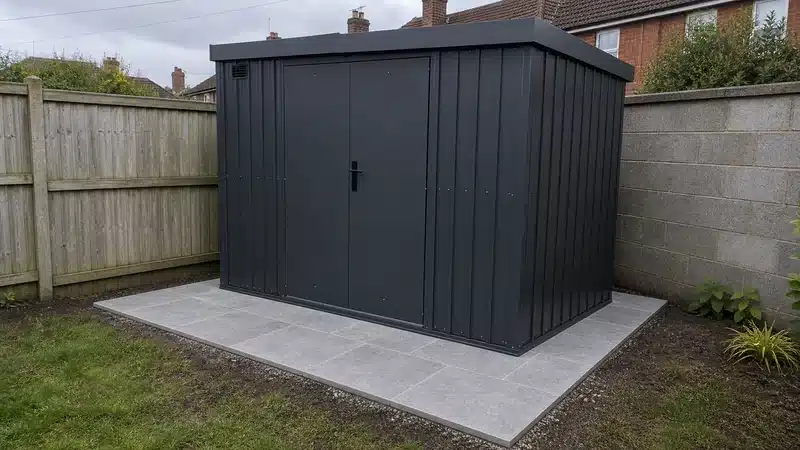
Modern, cool-toned gardens. Grey render houses, anthracite steel sheds, dark fencing, slate paving elsewhere – limestone slots in cleanly. The blue-grey tones complement modern garden design in a way sandstone can’t quite match.

Long-term low maintenance. If you don’t want to think about the base again for 20-plus years, Kilkenny limestone is genuinely the best of all the natural options. The denser material handles Dublin’s freeze-thaw cycles without surface damage, and the colour just gets better as it weathers.

Where the base is visible. Sometimes the shed base doubles as a small patio area or a clear feature in the garden layout. Limestone’s uniform appearance and tighter joint lines give a cleaner finish for that. Sandstone’s natural colour variation is gorgeous but can look busy if there’s a lot of it on show.

For a premium Kilkenny limestone shed base, the standard spec is 600mm x 600mm slabs in stretcher bond on a mortar bed, over 100mm of compacted 804 hardcore, with full perimeter mortar haunching to lock the edges in place. After 8-12 months of Dublin weather, expect a soft silvery patina to develop – that’s the limestone doing what good limestone does. The fresh blue-grey tone shifts toward something deeper and more characterful.
kilkenny limestone shed base dublin aged
Driveways and Patios place picture
4.9
Based on 107 reviews
Caroline Butler profile picture
Caroline Butler
3 days ago
Zim and his team did 2 pieces of work for us, originally we had a concrete base for a shed, and later had the concrete extended the full length of the garden. Both times the lads were great. They were respectful, efficient, friendly & very tidy. We’re delighted with the results & would highly recommend!
Barry Kestell profile picture
Barry Kestell
2 months ago
Brilliant job, very hard workers! Really happy with the results and highly recommend to anyone
declan davis profile picture
declan davis
2 months ago
I have never seen a contractor deliver this standard and finish of work. They arrived at 08:00am and were leaving each day at 7pm. Zim and his time were so organised & professional , incredible work ethic. He kept checking with my wife & I as he progressed and made suggestions which made the finished patio look amazing. The levels, stepping down and marrying into the house and garden is beautifully finished, thank you so much Declan & Ann Marie
Jennifer Jones profile picture
Jennifer Jones
3 months ago
Had Zim out to lay a slab of concrete for my shed. Would highly recommend him very clean and tidy.
John Kealy profile picture
John Kealy
3 months ago
Zim and his team put in a concrete base for a new garden shed. They showed up on time, did a fantastic job and made everything neat and tidy before leaving. Genuinely impressed and highly recommended. John
Lisa Courtney profile picture
Lisa Courtney
3 months ago
Zim and his team are excellent to deal with and their work is top notch. Delighted with our patio and would recommend to all. Thank you Zim.
Fabion Tahiraj profile picture
Fabion Tahiraj
3 months ago
Absolutely delighted with the shed base. Excellent workmanship, professional from start to finish, and left everything clean and tidy. The base is perfectly level and built to a very high standard. Highly recommend!
Shane Wallace profile picture
Shane Wallace
3 months ago
I am delighted with the great job that Zim and team did in my garden installing a porcelain patio, fencing and shed. The quality of the work is top class. It’s exactly what I wanted and delivered at a good price. I have already recommended Zim to many of my friends. Thanks again lads.
James Short profile picture
James Short
2 years ago
Zim was a pleasure to deal with. Brilliant service, quality workmanship, great communication throughout and excellent value for money. Would highly recommend Zim and his hard working team for any paving works.
Great job. Zim is very approachable and super nice. Our front yard needed few changes and Zim’s team have it done for us in one day. We are very happy and we highly recommend their service.
bbgs murphy profile picture
bbgs murphy
2 years ago
Would like to thank Zim and his crew for the wonderful work they did on our garden ,we had an old deck taken up and these beautiful porcelain tiles put down, the detail that was taken was just incredible , can't recommend Zim enough ,so professional and such clean work ,it was an absolute pleasure .thank you so much and looking forward to you coming back to do another job for us . Martin and Linda

What About Damp Under a Steel Shed?

Both materials need the same protection underneath. A DPM (Damp Proof Membrane) between the sub-base and the bedding layer is non-negotiable for steel sheds. Stone is porous – water will wick up through even a tightly jointed natural stone base if there’s nothing stopping it from below. We covered this in detail on our steel shed concrete base article, but the short version is: DPM goes down, lap the joins, run it up the sides by 100mm, and trim cleanly once the stone is laid. Skip this step and your shed floor will be wet by month three regardless of how nice the stone looks on top. Timber sheds are slightly more forgiving – the bearer rails lift the floor off the surface and air can move around. But for proper longevity we still spec a DPM under a natural stone base, full stop.

Sandstone vs Limestone – Quick Decision Guide

Here’s the short version if you’ve made it this far and you’re still on the fence.
  • Warm-toned house, want decent grip, watching the budget? Sandstone.
  • Cool-toned modern garden, want absolute lowest maintenance for 20+ years? Limestone.
  • Shed base is a feature, want clean uniform look? Limestone.
  • Shed base sits behind a tree, mostly out of sight? Honestly, either works, go with the cheaper option.
  • Wellies in and out every day in winter? Lean sandstone for the grip, or add a textured limestone finish.
And one more thing. Whichever stone you pick, the sub-base does the actual structural work. 150mm of properly compacted 804 hardcore with a clean DPM over the top will outlast the stone itself. We see way more failed natural stone bases from skimped sub-base prep than from the stone choice. Get that bit right and the rest is just aesthetics. For the full materials comparison across concrete, slabs, gravel, and panels, our shed base materials guide covers all four.

Thinking about a natural stone shed base but not sure which one suits your garden? Give us a ring on 086 458 3274 or fill out the form – we’ll come have a look, take into account what you’ve already got in the garden, and give you a straight answer on which stone makes sense and what it’ll cost.

Planning a new shed or garden room? Start with a foundation you can trust.

ShedBase Dublin specialises in high-quality shed base installation throughout Dublin, providing expert advice on concrete, paving slab, and gravel foundations to guarantee durability, stability, and long-term performance.

Contact us today

Request your free quote today and let our team deliver a precision-built shed base that guarantees stability and durability for years to come.
Click Here

FAQ - Sandstone vs Limestone Shed Base Dublin

Which lasts longer in Irish weather - sandstone or limestone?

Limestone, usually by a margin. The denser structure handles freeze-thaw cycles better than most sandstones, especially softer Indian grades. A properly laid Kilkenny limestone base will go 25 years or more with minimal attention. Indian sandstone typically gives you 15-20 years before joints need re-doing or surface spalling shows up. Both outlast a basic concrete pad on looks though, and that counts for plenty in a garden.

Limestone, especially the smoother modern finishes like honed Kilkenny or Irish blue limestone. The denser surface and lower porosity means rainwater sits on top rather than soaking in immediately. Sandstone’s slightly textured face holds grip much better when wet, which matters if you’re stepping in and out of the shed in wellies during a wet Dublin winter. Worth thinking about even before you choose the colour.

No. Both materials need a proper sub-base or they’ll move, crack at the joints, and rock underfoot within a single winter. Standard build is 150mm of compacted 804 hardcore, a DPM layer over the top, then either a 30-40mm sharp sand bed or a full mortar bed depending on the finish. Skipping the sub-base is the single biggest reason natural stone bases fail. We see it every year.

For a standard 2.4m x 1.8m (8ft x 6ft) base in Dublin, you’re paying roughly €100-€300 more for sandstone or limestone over a poured concrete pad. Indian sandstone is the most affordable natural option at around €130-€160 per m². Premium Kilkenny limestone tops out at €210 per m². Bear in mind these are guide figures – the final price always depends on how much ground preparation your garden needs, which is the biggest single variable on any base job.

Depends what you’re after. Sealing slows down weathering and reduces the chance of staining (helpful if you keep a lawnmower with a petrol tank on the base). But it also prevents the lovely natural patina that develops over a few winters, which most Dublin customers actually want. Our standard advice is don’t seal unless there’s a specific reason. The stone is meant to age. That’s half the appeal.

Usually it shows up in the first 6-12 months as natural salts work out of the stone and the mortar bed. A stiff-brush down every couple of weeks during that period sorts it. After year one it generally settles and you won’t see it again. If it keeps reappearing past 18 months, that’s usually a sign of trapped damp from below – which is exactly what a proper DPM prevents in the first place.

Want a Straight Answer for Your Garden?

Right. Done reading. Best thing now is to give us a call on 086 458 3274 or drop us a message – we’ll come out, take a look at the garden, see what the soil’s like and what the access is, and tell you straight what your shed actually needs. No upselling.

If you want to see the full picture of all your base options before deciding, our shed base installation guide covers everything. Going for the budget route? The gravel shed base page has the full breakdown.

📞 Call us at 086 458 3274 📧 Email us at [email protected] Don’t wait – your new shed (and the perfect base) is just a call or click away!
Zim, owner at Driveways & Patios Dublin
Zim
“Bringing over 20 years of quality craftsmanship to Dublin’s shed bases and garden sheds – committed to delivering exceptional results and ensuring complete customer satisfaction.”