Does a Steel Shed Need a Concrete Base? A Dublin Installer's Honest Answer (2026)
Look, this is probably the question we get asked most often. The shed has just been ordered, the delivery date is locked in, and now somebody at the supplier has mentioned the word “concrete” and the customer is starting to sweat about the bill.
Honest answer? Most steel sheds in Dublin don’t strictly need a poured concrete base. Smaller models from Sheds Direct Ireland or Steeltech sit perfectly fine on a properly compacted gravel base or on paving slabs, as long as a DPM is fitted underneath. Heavier steel buildings, anything over 3m x 2.4m (10ft x 8ft), or workshops with real weight inside – that’s where concrete becomes the only sensible call.
That’s the short version. Now let me explain it properly, because there’s a few things that make a real difference.
Why Everyone Tells You “You Need Concrete”
Because it’s the safe answer. If a supplier or a generalist landscaper tells you to pour concrete, they’re never wrong. Concrete works for every steel shed ever made. It’s bombproof, level, dry, and stable.
But – and this is the bit nobody mentions – concrete also costs you somewhere between €430 and €1,080 depending on the shed size. For a small storage shed worth €400 retail? That maths doesn’t really add up.
Thing is, a lot of steel sheds in Dublin gardens are sitting on much cheaper bases and doing absolutely fine. The trick is knowing which job needs what.
When a Steel Shed Doesn’t Need Concrete
Plenty of times, honestly. Here’s the rough rule we go by on site visits in Dublin 15.
Gravel or paving slab bases work for:
- Small to medium steel sheds. Anything up to about 2.4m x 1.8m (8ft x 6ft) for storage, the kind of thing you put bikes and a lawnmower in.
- Steel sheds from Sheds Direct Ireland that come with EcoBase modular panels included. The plastic grid is designed to sit on a gravel sub-base.
- Light-use sheds. Tools, garden furniture, kids’ bikes – none of that puts concentrated load on the floor.
- Gardens with decent drainage. If the soil isn’t permanently waterlogged, gravel handles the moisture better than concrete does.
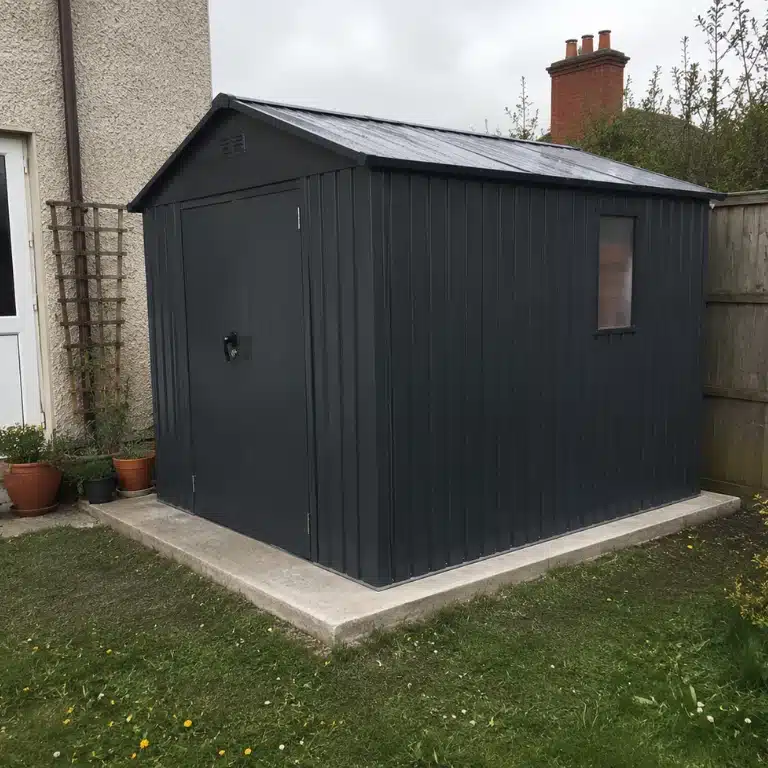
We did a job in Castleknock last spring. Sheds Direct steel shed, 2.4m x 1.8m (8ft x 6ft), customer wanted the EcoBase panels. Compacted 804 hardcore sub-base, panels on top, gravel fill. Done in half a day. Total base cost was around €420. The shed went on the next morning. Two years on, it’s level, dry, and fine. No concrete in sight.
For the full breakdown of when each base type makes sense, our shed base materials guide walks through all four options side by side.
When Concrete Actually Is Non-Negotiable
Different story now. Some steel sheds genuinely need a poured pad and there’s no clever way around it.
Concrete is the only call when:
- The shed is over 3m x 2.4m (10ft x 8ft). Bigger footprint, more weight, and the floor won’t stay level on gravel long-term.
- It’s a garden office or workshop. Even if the building is steel-framed, the moment you put a desk, machinery, or a workbench inside, the load concentrates and gravel will start to settle.
- You’re storing heavy gear. Ride-on mowers, gym equipment, woodworking tools – that kind of weight needs rigid support underneath.
- The garden is on heavy clay soil with persistently bad drainage. Concrete laughs at clay. Gravel doesn’t.
- The shed manufacturer specifies it. Steeltech, for example, asks for a “picture frame” base on certain ranges and they’ll ask for a photo before honouring the warranty. Read the brochure properly before you start.
In any of those cases, our concrete shed base Dublin page covers the full process – mix grade, depth, curing time, the lot.
The DPM Thing – Critical for Steel Sheds
Right, this bit applies whatever base you go with. So pay attention.
Steel sheds get condensation. Fact. The metal cools at night, warm air inside hits it, and you get water droplets forming on the inside walls. Add ground moisture rising up from underneath, and within two winters the floor of your shed smells like a wet sock.
That’s where the Damp Proof Membrane comes in. A DPM is a heavy plastic sheet that goes between the ground (or the base) and the shed itself. Stops moisture from below ever reaching the steel.
For concrete bases, the DPM goes underneath the concrete – or sometimes on top, depending on the design. For gravel bases, it goes between the gravel surface and the shed floor itself. For paving slabs, on top of the slabs before the shed lands.
Non-negotiable for steel. Honestly. Skip it and you’ll be cleaning rust off your tools by year three.
Brand by Brand – What Each Manufacturer Asks For
Different shed brands have different requirements. Here’s what we see most in Dublin gardens.
Sheds Direct Ireland. Their assembly team delivers and installs the shed – but they don’t install bases. They sell EcoBase modular plastic panels which work on a properly compacted gravel sub-base. Smaller models can sit on paving slabs. For their bigger steel buildings, they recommend concrete.
Steeltech. This one’s stricter. Many of their CE-approved ranges require a “picture frame” perimeter base – usually concrete with a specific depth and width depending on the model. They’ll ask for photo proof before the shed is delivered. Don’t try to wing it. Check the product brochure or call them before you order.
Adman Steel Sheds. Generally happy with a level concrete pad. Smaller models can work on slabs.
Generic / online steel sheds. No real spec, just “needs to be level”. This is where most people end up choosing gravel for the smaller ones and concrete for anything serious.
The point is: read the manufacturer guide before you decide. Two minutes on their website saves you a warranty headache later.
A Real Dublin Job – Steel Shed in Dublin 15
Here’s one that came through last autumn, just to put a face on the numbers.
Customer in Blanchardstown had ordered a Steeltech steel shed, 3m x 2.4m (10ft x 8ft), to use as a small workshop. Lawnmower, woodworking bench, a few power tools. Heavy clay soil, no side gate, terraced house. Materials had to come through the kitchen.
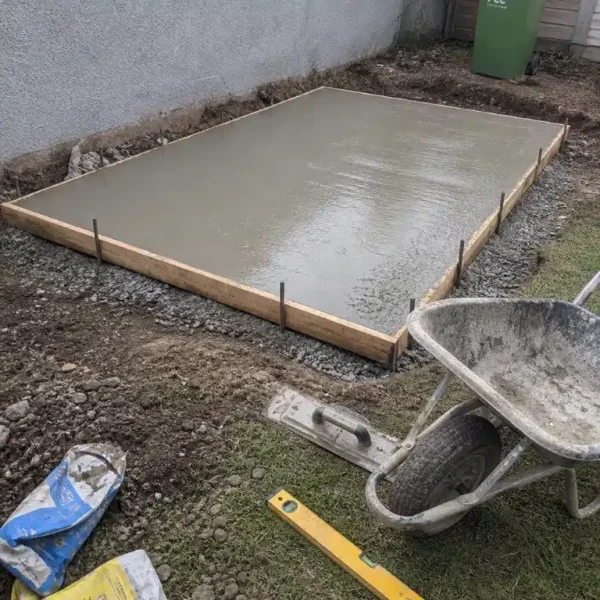
Steeltech’s spec for that range required a perimeter concrete base. So that’s what we did. Excavated 250mm down because of the clay, laid 150mm of 804 hardcore, compacted it properly with the whacker plate, then poured a C25 concrete pad with timber formwork. Curing time 72 hours because the weather was damp.
Total cost was around €780 because of the access and the deeper dig. Without the kitchen-wheelbarrow palaver and on standard soil it would’ve been closer to €650.
Job done. Two years on, still rock solid. The customer’s running a small woodworking hobby in there now and the floor hasn’t moved a millimetre.
Cost Comparison – Steel Shed Bases in Dublin (2026)
Just so you know what each option lands at for a standard 2.4m x 1.8m (8ft x 6ft) steel shed.
| Base Type | Cost (Materials + Labour) | Best For | Curing Time |
|---|---|---|---|
| Stabilised gravel | €260 – €390 | Small light-use steel sheds | None – shed goes on same day |
| Paving slabs on sub-base | €540 – €820 | Small to medium sheds, neat finish | None – next day at most |
| EcoBase modular panels | €380 – €550 | Sheds Direct sheds, light steel | None – same day |
| Concrete pad (C20-C30) | €430 – €645 | Heavy sheds, workshops, offices | 48-72 hours |
Pricing update, September 2026: our paving slab bases are now €125 – €190 per m², around 25% above an equivalent poured concrete base. Slabs use more materials and every one of them is bedded and levelled by hand. The final price depends on size, ground preparation and access.
Prices vary based on access, soil type, and whether you’re on Dublin 15 clay or somewhere with better drainage. For the full pricing picture across all base types, have a look at our shed base cost guide for Dublin.
Planning permission, updated 9 August 2026. Since 27 July 2026 garden structures of up to 30 m² are generally exempt from planning permission, up from 25 m². You still have to leave at least 25 m² of private open space, and height limits apply.
How to Get in Touch
If you need some advice on what kind of base would work best for your new shed we are happy to do free consultations and give you a quote without any hassle.
You can give Zim a ring directly on 086 458 3274 to discuss your garden, or if you prefer you can use our contact form and we will get back to you to arrange a time to visit.
Planning a new shed or garden room? Start with a foundation you can trust.
Contact us today
Frequently Asked Questions
Will a steel shed rust if it's not on concrete?
Not because of the base type itself. Steel sheds rust because of moisture – either rising damp from the ground or condensation forming inside. A proper DPM under the shed solves both problems, regardless of whether the base underneath is concrete, gravel, or paving slabs. Concrete actually traps moisture if there’s no DPM. Gravel breathes better. The base material isn’t the issue. The damp proofing is.
Does Steeltech require a concrete base on every shed?
No, but plenty of their ranges do require one. Steeltech is strict about base requirements because they back their warranties with photo verification. For their bigger ranges, you’ll typically need a poured concrete perimeter or pad to a specified depth. Smaller storage models can sometimes go on a level paving slab base. Always check the product brochure or call them before you order. Don’t assume.
Can I put a Sheds Direct steel shed on grass?
Honestly? You can. For about three months. Then the ground softens, the shed starts settling unevenly, the door catches in the frame, and there’s a smell of damp every time you open it. Sheds Direct themselves recommend a proper level base – either gravel with EcoBase panels, paving slabs, or concrete depending on the size. Saving money by skipping the base costs you a full shed replacement within five years. Not worth it.
How thick should concrete be for a steel shed?
For smaller residential sheds (under 8ft x 6ft), we’ll often set the base directly on properly prepared ground – no full dig-out needed. For bigger sheds and garden offices, the spec is 100mm of concrete on top of 100mm of compacted 804 hardcore. For workshops or heavier buildings, step up to 150mm of concrete on 150mm of hardcore. Mix grade is normally C20 for general use, C25 or C30 for anything carrying real weight or used as a workshop. Curing needs 48-72 hours minimum before the shed goes on, longer if the weather’s damp.
Is concrete or gravel better for drainage around a steel shed?
Gravel. By a long way. Gravel is permeable, so rainwater runs straight through into the ground. Concrete is solid, so water either runs off the edges into the surrounding garden or pools on the surface. For a steel shed in clay-heavy parts of North Dublin, gravel actually performs better in winter – as long as the sub-base is properly compacted. Concrete only wins on weight capacity, not on water management.
What happens if my steel shed is on an uneven base?
Bad things, slowly. The frame twists, the door starts catching, the corners pull apart at the seams, and the roof sheets can shift. Steel sheds need a base that’s level to within a few millimetres across the full footprint. That’s why DIY gravel bases often fail – the compaction isn’t right, the base settles unevenly over the first wet winter, and the shed warps. Get the base level from the start and the shed lasts twenty years. Easy peasy.
Want a Straight Answer for Your Garden?
Right. Done reading. Best thing now is to give us a call on 086 458 3274 or drop us a message – we’ll come out, take a look at the garden, see what the soil’s like and what the access is, and tell you straight what your shed actually needs. No upselling.
If you want to see the full picture of all your base options before deciding, our shed base installation guide covers everything. Going for the budget route? The gravel shed base page has the full breakdown.
📞 Call us at 086 458 3274 📧 Email us at [email protected] Don’t wait – your new shed (and the perfect base) is just a call or click away!